Of all the online risks facing teenagers today, this is the one that has grown fastest and that most parents know least about, and that gap is dangerous, because sextortion moves at terrifying speed and the right response in the first hour makes an enormous difference. It is also one of the few online harms that has, tragically, cost young people their lives, driven by a panic and shame that the whole scheme is engineered to produce. So this guide is deliberately clear and practical. If you read only one article about online safety this year, this is a strong candidate, because the knowledge here can genuinely protect your child.
We will explain what sextortion is, how it typically unfolds, why it hits teenagers so hard, and, most importantly, exactly what to do, both to prevent it and to respond if it happens. We will also be direct about the single most important thing you can do today, which costs nothing and takes one conversation.
What sextortion is
Sextortion is blackmail using sexual images. Someone obtains, or claims to have obtained, an intimate image of a young person, and then threatens to share it, with family, friends, the whole school, unless the victim pays money or sends more images. It is a crime, and the young person is the victim, full stop, no matter how the first image came to exist.
That last point matters enormously and we will return to it, because the shame that makes a teenager feel they cannot tell anyone is the exact mechanism the offender relies on. Understanding that your child is a victim of a crime, not a wrongdoer who brought it on themselves, is the foundation of every helpful response.
How it typically unfolds
The pattern is disturbingly consistent, and knowing it helps you and your child recognise it before it escalates.
It usually starts with a stranger making contact on social media or a game, very often using a fake profile of an attractive young person of around the victim’s age. There is a fast, flirtatious build-up, sometimes over just hours, designed to move quickly to the exchange of intimate images. Often the offender sends what appears to be an image first to lower the victim’s guard and make it feel mutual. The moment the victim sends an image, everything changes: the warmth vanishes and the threats begin. Pay this amount, usually to a specific app or in gift cards or cryptocurrency, or the image goes to everyone you know. To make the threat real, offenders frequently already have, or quickly gather, the victim’s friends and family contacts.
Two features distinguish this from the slower process of grooming. First, the speed: financially-motivated sextortion can go from first contact to active blackmail within a single evening, which leaves no time for the usual warning signs to accumulate. Second, the motive: a large share of it is straightforward organised financial crime, run at scale, sometimes from overseas, targeting many victims at once. It is worth knowing that boys, particularly teenage boys, are very heavily targeted in these financial schemes, which cuts against the assumption that this is only a risk for girls.
Why it hits teenagers so hard
To an adult, the “solution” can look obvious: block them, it is a bluff, move on. To a teenager in the grip of it, it feels like the actual end of the world, and understanding why is essential to responding well.
A teenager’s whole social universe is their peers, and the threat is aimed precisely at that: the humiliation of the image reaching everyone they know feels unsurvivable. On top of that sits a crushing weight of shame and the certainty that they are in terrible trouble, which convinces them they cannot possibly tell a parent. The offender deliberately manufactures panic and urgency, “pay in the next ten minutes or I send it now”, to stop the victim thinking clearly or reaching out. That combination, maximum shame, maximum fear, maximum urgency, is engineered to isolate the young person at exactly the moment they most need an adult. Recognising that the panic is a deliberate tool, not a reflection of how bad the situation truly is, is part of what helps a family respond calmly.
The most important thing you can do, today
Prevention is partly about the usual sensible settings, private accounts, caution with strangers, which we cover across our other guides. But the single most powerful protection against sextortion is one specific conversation, and you can have it tonight.
Tell your child, in your own words and before anything ever happens, something like this: “If you ever send a photo you regret, or someone online threatens you over a picture, you can come straight to me. You will not be in trouble. I will not be angry, and I will not take your phone away. We will sort it out together, and there is always a way out.” Say it clearly, and mean it.
Here is why this matters more than any filter. The offender’s entire power rests on one thing: the victim’s belief that they are alone and cannot tell anyone. The threats only work while the child stays silent. The moment your child tells a trusted adult, the offender’s leverage collapses, because the thing they are threatening to reveal is already known to the one person whose reaction the child feared most. By promising, in advance, that telling you is safe, you hand your child the exact key that unlocks the trap. This one conversation, more than any technology, is what saves young people from the worst outcomes.
If it is happening: what to do, and what not to
If your child comes to you, or you discover this is happening, the first hour matters. Here is the clear version, and it is worth knowing before you ever need it.
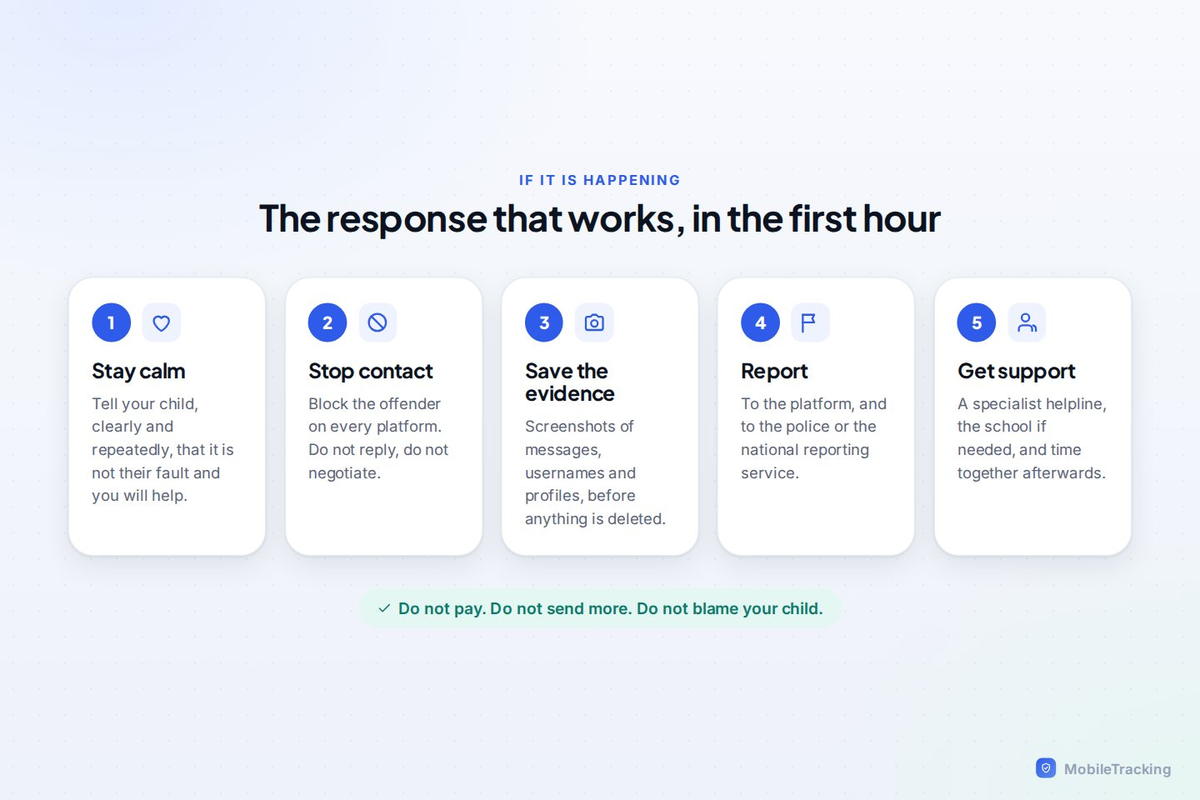
On the do side: stay calm and tell your child, clearly and repeatedly, that it is not their fault and you are going to help. Stop all contact with the offender, block them across every platform. Save the evidence first, screenshots of the messages, the username, the profile, before blocking, because it matters for reporting. Report it: to the platform (most major services have a dedicated, fast route for this), and to the police or your country’s reporting body. And get support, a specialist helpline, a counsellor, the school if relevant, because your child will need emotional help, not just practical steps.
On the do not side, and these are just as important: do not pay. Paying rarely stops the demands and usually invites more, because it marks the victim as someone who will pay. Do not send any further images, whatever is threatened. Do not delete the evidence before you have reported it. And above all, do not blame or punish your child for the first image, because that reaction confirms their worst fear and shuts down the trust you need to help them through it. Handle it with them, not against them.
A crucial point about taking the image down
One of the deepest fears a young victim has is that the image is now out of their control forever. That is not the whole truth, and telling your child so can lift an enormous weight.
There are dedicated services designed to help remove intimate images of under-18s from the internet. Tools such as Take It Down (run by NCMEC in the US) and Report Remove (run by the NSPCC and IWF in the UK) let a young person, with support, get sexual images of themselves detected and taken down across participating platforms, often without the image itself ever having to be handed to a stranger. Knowing that these services exist, that there is a concrete way to fight back and that they are not powerless, is genuinely important for a frightened teenager, and worth mentioning to your child as part of the reassurance that there is always a way out.
Prevention, beyond the big conversation
The conversation is the heart of it, but a few habits reduce the odds of your child ever being in this position. Talk about the specific mechanics of the scam, plainly: that a friendly stranger who moves fast toward images is a classic warning sign, that people online are often not who they claim, and that anyone can be targeted, boys very much included. Encourage healthy caution about sending intimate images to anyone, framed not as shaming but as protecting themselves. Keep social accounts private and be wary of contact from strangers, since that first contact is where it starts. And use the safety features that help, some platforms now automatically blur suspected nude images sent to minors and warn them, which is a useful, low-friction safety net.
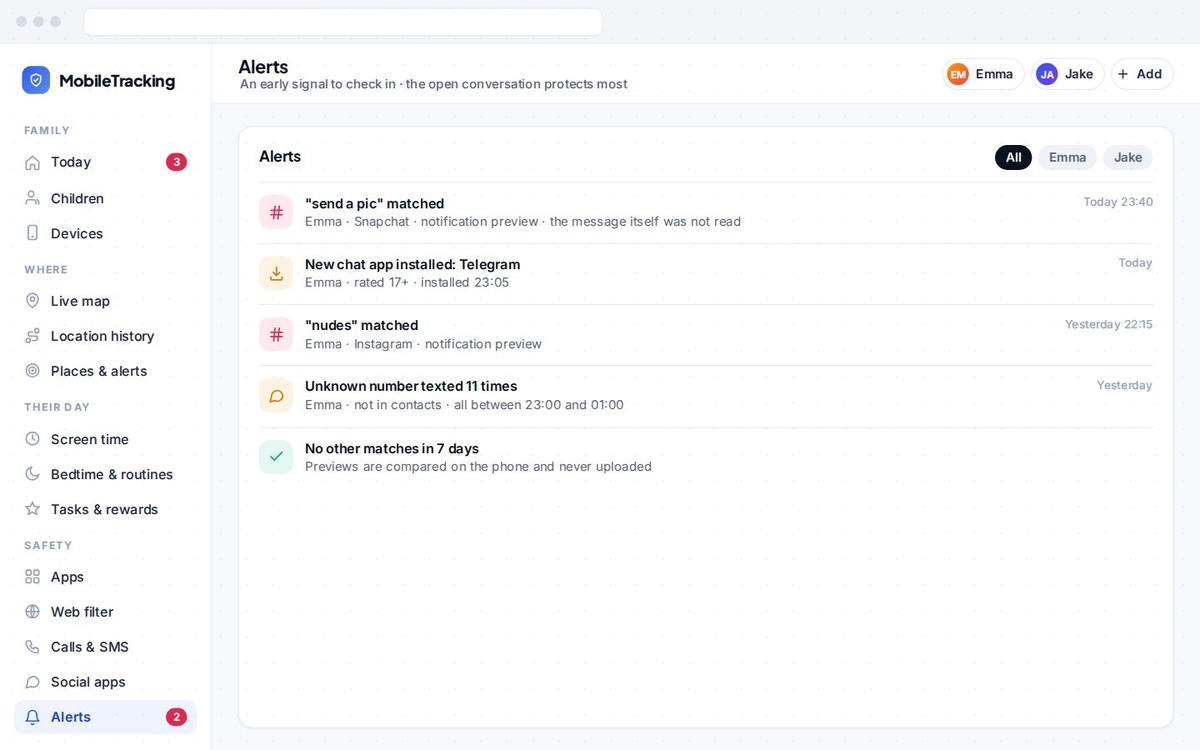
It is worth being honest that sextortion’s speed makes it harder to catch with monitoring than slower harms; it can begin and escalate in one evening. That is precisely why the pre-agreed promise, that your child can come to you without punishment, does more than any alert. The technology can occasionally give you an early nudge; the relationship is what your child reaches for in the moment it matters.
In short
Sextortion is frightening, fast, and increasingly common, and it targets ordinary teenagers, including boys, through the apps they use every day. But it has a specific weakness: it depends entirely on the victim’s silence. Arm your child with the knowledge of how the scam works, and arm them with the certainty that they can come to you without shame or punishment, and you have removed the offender’s only real weapon. If it ever happens, stay calm, do not pay, save the evidence, report it, and get support, and know that there are services to help take images down. Your steady, non-judgemental response is the thing that gets a young person safely through this.
What MobileTracking adds
MobileTracking plays a supporting role here, because sextortion moves faster than any monitoring tool can. It can flag when a new messaging app appears on the phone, alert you to keywords you are watching for, and show you unusual patterns of activity, all of which can occasionally give you an earlier chance to check in. But the honest message is that no app substitutes for the one conversation that actually protects your child: that they can come to you, without blame or punishment, the instant something goes wrong. MobileTracking is built to support that openness, on a phone your child knows is monitored, not to replace it.
Frequently asked questions
What is sextortion?
Sextortion is blackmail using sexual images: someone obtains or claims to have an intimate image of a young person and threatens to share it unless the victim pays money or sends more images. It is a crime, and the young person is always the victim, regardless of how the first image came to exist.
What should my child do if they are being sextorted?
Come to a trusted adult straight away. Then: stop all contact and block the offender, save the evidence first (screenshots, username, profile), report it to the platform and the police or a national reporting body, and get support. Do not pay, do not send more images, and do not delete the evidence before reporting.
Should we pay to make it stop?
No. Paying rarely stops the demands and usually leads to more, because it marks the victim as someone who will pay. The right move is to stop contact, preserve evidence, and report it, not to comply.
Are boys at risk of sextortion too?
Very much so. Teenage boys are heavily targeted in financially-motivated sextortion schemes, which are often run as organised crime at scale. The assumption that this only happens to girls is wrong and can leave boys unprepared, so have the conversation with children of any gender.
Can a sexual image of my child be taken down?
Yes, there are dedicated services for exactly this, such as Take It Down (NCMEC) in the US and Report Remove (NSPCC and IWF) in the UK, which help detect and remove intimate images of under-18s across participating platforms, often without the image being handed to a stranger. Telling your child these exist can lift a huge weight of fear.
Keep going
Read our guides on online grooming, AI chatbots and kids, and cyberbullying. For trusted guidance beyond this site, Common Sense Media is a well-regarded resource for parents: Common Sense Media.
If your child is being sextorted, they are the victim of a crime. Do not pay. Save the evidence, then report it to the platform and to your country’s reporting body (in the US, the NCMEC CyberTipline and Take It Down; in the UK, CEOP and Report Remove). If a child is in immediate danger, contact your local emergency services. This article is general information, not legal advice.