This is the subject most parents least want to read about, and the one it is most worth understanding, because online grooming is not a rare, faraway horror that happens to other families. It is a real risk that lives inside the ordinary apps and games your child already uses, and the single biggest protection against it is a parent who knows the pattern and has built the kind of relationship where their child would actually tell them if something felt wrong. That is the whole aim of this guide: not to frighten you, but to make you the person your child comes to.
We will cover what grooming actually is, the pattern it tends to follow, the warning signs worth knowing, and, most importantly, what to do, both to reduce the risk in advance and to respond if you are ever worried. It is a hard topic, so we will be clear and calm about it, because panic helps no one and understanding helps a great deal.
What online grooming is
Grooming is the process by which an adult builds an emotional connection with a child in order to abuse them, whether that abuse is getting sexual images, arranging to meet, or exploiting them in other ways. Online, it happens in the places children naturally gather: social media, games with chat, video platforms, messaging apps. The groomer does not usually announce themselves as a threat. The whole method is to seem like the opposite of one, a friend, an admirer, someone who understands and pays attention.
Two facts are worth holding onto because they cut against the reassuring stories we tell ourselves. First, groomers very often pose as someone your child’s own age, or close to it, so “they’d know an adult stranger” is not the protection it feels like. Second, this can happen to any child; it is not only the obviously vulnerable ones, though loneliness, low confidence, and a difficult time at home do raise the risk, because they are exactly the needs a groomer offers to meet.
The pattern it tends to follow
Grooming is not usually a single dramatic moment; it is a gradual process, and knowing its shape is what lets you recognise it early, when any single step still looks innocent. It does not always run in a neat order, but the pattern below is common enough to be worth learning.
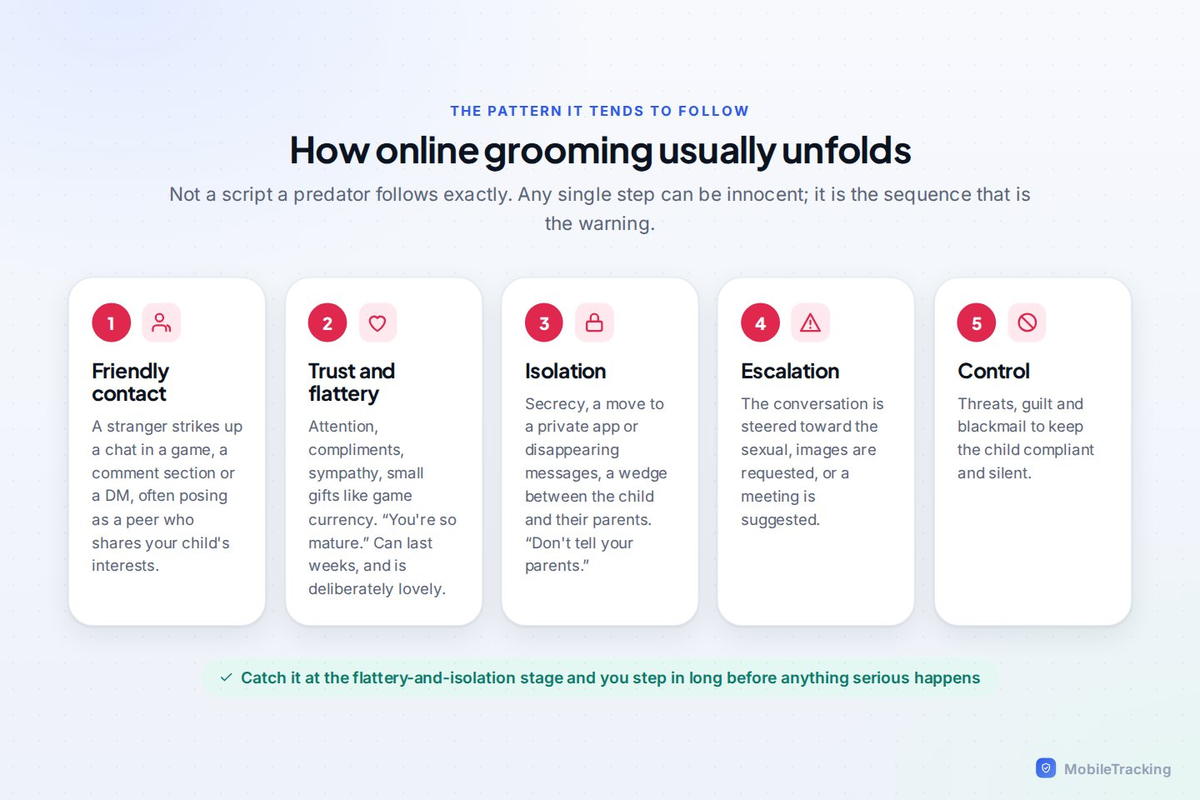
It often begins with friendly contact: a stranger strikes up a conversation in a game, a comment section, or a direct message, frequently posing as a peer who shares your child’s interests. Then comes trust and flattery: lots of attention, compliments, sympathy, small gifts (game currency, for instance), and the sense of being specially understood, “you’re so mature”, “you get me in a way others don’t”. This stage can last weeks, and it is deliberately lovely, which is what makes it effective.
Next is usually isolation: the groomer encourages secrecy and works to move the conversation onto a private channel, a different app, disappearing messages, a game’s DMs, and to drive a quiet wedge between the child and their parents or friends. “Don’t tell your parents, they wouldn’t understand” is the signature move, because secrecy is the tool that makes everything after it possible. Then escalation: the conversation is steered toward the sexual, images are requested, or a meeting is suggested. And finally, if it gets that far, control: threats, guilt, and blackmail to keep the child compliant and silent.
The reason to learn this sequence is that the early stages, a new online friend, lots of attention, a nudge toward a private app, look harmless in isolation and are easy to miss. Catch the pattern while it is still at the flattery-and-isolation stage and you can step in long before anything serious happens.
Warning signs worth knowing
No single one of these proves anything, teenagers are private and moody by nature, but a cluster of them appearing together is worth paying calm attention to:
- A new online “friend” they are secretive about, or become defensive when asked about.
- Spending much more time online, especially late at night, and hiding the screen when you come near.
- New gifts, game currency, or items they can’t or won’t explain.
- Being withdrawn, anxious, or emotionally up and down, particularly after being online.
- Using sexual language or showing knowledge that seems beyond their age.
- Switching to apps with disappearing messages, or a new account you didn’t know about.
- Talk of someone online they’ve grown close to but have never met in person.
The point of knowing these is not to interrogate your child at the first sign, which usually backfires, but to notice, and to open a calm, curious conversation rather than an accusation. The difference between “I’ve noticed you seem to have a new friend online, tell me about them” and “who is this person, show me your phone right now” is the difference between a door opening and one slamming shut.
Reducing the risk in advance
Prevention is a mix of a few sensible technical steps and, far more importantly, the conversations and the relationship. The technical part is genuinely worth doing, but it is the smaller half.
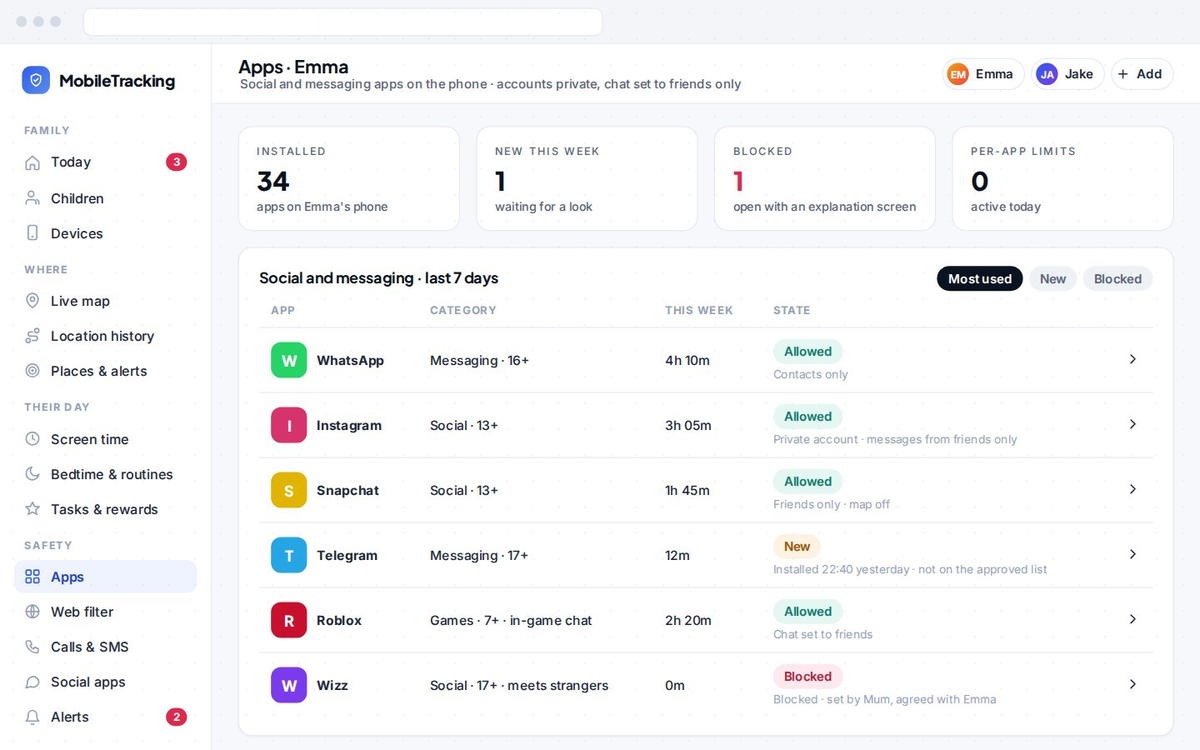
On the practical side: keep social and gaming accounts private, and set chat and messaging to friends only where you can, so strangers cannot freely make contact in the first place. Know which apps and games your child uses, and roughly how they work, especially which ones let strangers message children. Keep devices in shared spaces where you can, particularly for younger children, and keep them out of the bedroom overnight, because the private, late-night, unsupervised hours are exactly when grooming conversations deepen. And use content filtering and the platforms’ own safety tools to close off the worst avenues.
The conversations that do the real protecting
Here is the uncomfortable truth about grooming: no filter, setting, or monitoring app can fully protect a child, because the whole method targets the child’s emotions and trust directly. The strongest protection by far is a child who knows the warning signs, feels able to talk to you, and believes you will help rather than punish. That is built through conversation, over time, and it is worth more than any technology.
Talk, in age-appropriate ways, about the fact that people online are not always who they say they are, and that someone claiming to be a twelve-year-old could be anyone. Teach the specific rules that break the pattern: never share personal information, real name, school, address, photos, with someone met online; never move a conversation to a private app just because someone asks; and be deeply wary of anyone who wants to keep a secret from your parents, because that request is itself the red flag.
Above all, land this one message and repeat it: “If anyone online ever makes you uncomfortable, asks you to keep a secret, asks for a photo, or wants to meet, you can always tell me. You will never be in trouble, and I will never take your phone away as a punishment for telling me.” That promise is the linchpin. The reason groomed children stay silent is almost always shame and fear of the adult reaction, of being blamed, or of losing the device and the friendships attached to it. A groomer relies on that silence. You break their most important tool by making sure, in advance, that your child knows the door is open and safe.
The role of monitoring, honestly
A parental-control tool has a real but limited role here, and it is worth being precise about it rather than overpromising. What software genuinely helps with is the early, structural stuff: flagging when a new messaging app appears on the phone (which matters, because moving to a private app is a core part of the pattern), alerting you to concerning keywords, showing you a spike in late-night activity, and helping enforce the shared-space and no-phone-overnight boundaries that reduce the risk.
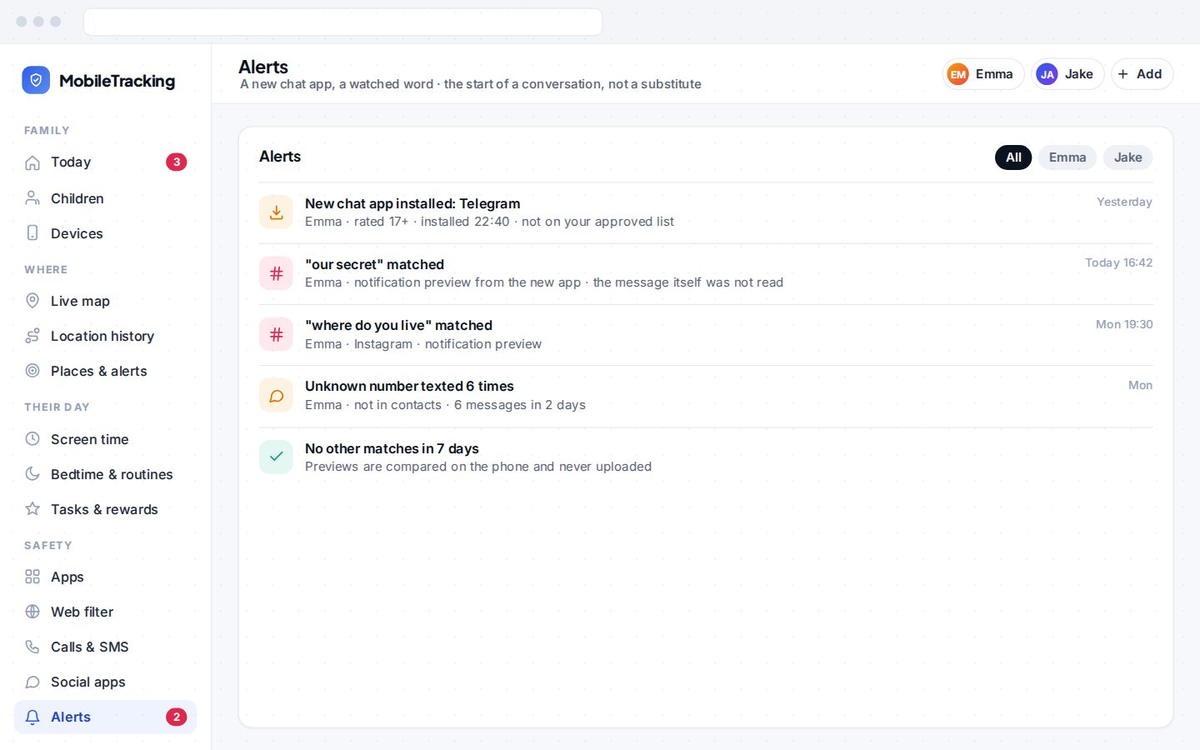
What monitoring cannot do is read the emotional subtext of a grooming conversation or replace your child’s own judgement and willingness to come to you. Used as one layer, alongside open conversation and sensible settings, it is genuinely useful, an early-warning system that can prompt a conversation sooner. Used as a substitute for the relationship, in secret, it is both less effective and likely to damage the very trust that protects your child most. Overt, explained monitoring supports the conversation; covert surveillance quietly undermines it.
If you are worried right now
If you suspect your child is being, or has been, groomed, the priority is to respond in a way that keeps them safe and keeps them talking, not one that makes them regret telling you.
Stay as calm as you can, even though it is frightening, because your child is watching your reaction to decide whether telling you was safe. Reassure them that it is not their fault, that they have done the right thing, and that you are going to help. Do not blame or punish them, and do not confront the groomer yourself. Preserve the evidence rather than deleting it: keep the messages, usernames, and profiles, because they matter for any report. Then report it: to the platform, to the police or your country’s child-protection or online-abuse reporting body, and, if you need guidance, to a specialist helpline. In the UK, for example, the CEOP Safety Centre takes reports about online child sexual abuse and grooming; most countries have an equivalent. You do not have to handle this alone, and you should not try to.
The takeaway
Online grooming is real, and it is worth taking seriously, but the response is not fear or locking your child away from the internet. It is knowledge and relationship: understand the pattern so you can spot it early, put sensible settings and boundaries in place, and, above everything, be the parent your child would come to without hesitation if something felt wrong. That relationship, more than any app or setting, is what keeps a child safe.
Where MobileTracking fits
MobileTracking supports the early-warning and boundary side of this. It flags when a new messaging app appears on the phone, which matters because moving to a private channel is a core part of how grooming progresses, lets you set keyword alerts for words you would never want to miss, shows you patterns like a spike in late-night use, and helps you keep the screen-time and overnight boundaries that reduce the risk. It is built to be visible on the child’s phone and to prompt a conversation earlier, not to replace the open, trusting relationship that is a child’s real protection.
Frequently asked questions
What is online grooming?
It is the process by which an adult builds an emotional connection with a child online in order to abuse them, whether that means obtaining sexual images, arranging to meet, or other exploitation. It happens in ordinary apps and games, and the groomer typically poses as a friend or a peer rather than an obvious threat.
What are the warning signs a child is being groomed?
Look for a cluster rather than one sign: a secretive new online friend, much more time online especially late at night, unexplained gifts or game currency, becoming withdrawn or anxious, sexual language beyond their age, switching to disappearing-message apps or hidden accounts, and talk of someone online they’ve never met. Any one alone can be nothing; several together warrant a calm conversation.
How can I protect my child from online grooming?
Combine sensible settings, private accounts, friends-only chat, devices out of the bedroom overnight, content filtering, with the far more important work of conversation: teach them that people online may not be who they claim, that secrets and moving to private apps are red flags, and above all that they can always come to you without being blamed or punished.
What should I do if I think my child is being groomed?
Stay calm and reassure them it is not their fault. Do not blame or punish them, and do not confront the groomer yourself. Preserve the evidence, messages, usernames, profiles, rather than deleting it, then report it to the platform and to the police or your country’s child-protection reporting body, and seek support from a specialist helpline. You do not have to handle it alone.
Can a parental control app prevent grooming?
Not on its own. Software genuinely helps with the early, structural signals, flagging a new chat app, alerting on keywords, showing late-night spikes, and enforcing boundaries, but it cannot read the emotional subtext of a grooming conversation or replace your child’s willingness to come to you. Use it as one visible layer alongside open conversation, not as secret surveillance, which undermines the trust that protects them most.
Keep going
Read our guides on sextortion and what parents need to know, cyberbullying, and the social apps teens actually use. For trusted guidance beyond this site, Common Sense Media is a well-regarded resource for parents: Common Sense Media.
If a child is in immediate danger, contact your local emergency services. To report online child sexual abuse or grooming, use your country’s dedicated reporting body (in the UK, the CEOP Safety Centre; in the US, the NCMEC CyberTipline). A specialist helpline can also advise and support you.