If you’ve landed here because you think your child is being cyberbullied, start with three things, because they’re the ones that matter most and they’re easy to get wrong in the heat of the moment. It is not your child’s fault. Taking their phone away is usually the wrong first move. And your own calm in the first day will do more good than anything a piece of software can.
Cyberbullying is bullying that follows a child home through their phone. That’s the whole reason it’s so corrosive, there’s no walking away from it, no front door to close behind you. It arrives in the bedroom, at the dinner table, at midnight. This guide covers how to spot it, exactly what to do in the first 24 hours, how to report it on the major platforms, and how to help your child come out the other side whole.
It’s written to be read by a worried parent at 11pm, so it’s plain and practical. Take what you need and leave the rest.
What cyberbullying actually looks like
It’s broader than the word “bullying” might suggest, and recognising the range helps you spot it. Cyberbullying includes cruel comments and direct messages; spreading rumours or sharing private information; deliberate exclusion, like being cut out of a group chat everyone else is in; impersonation, where someone poses as your child to embarrass them; sharing humiliating or doctored photos; and “pile-ons,” where a crowd turns on one child at once. It happens on social media, in games, in group chats, and increasingly through anonymous question-and-answer apps that bolt onto other platforms.
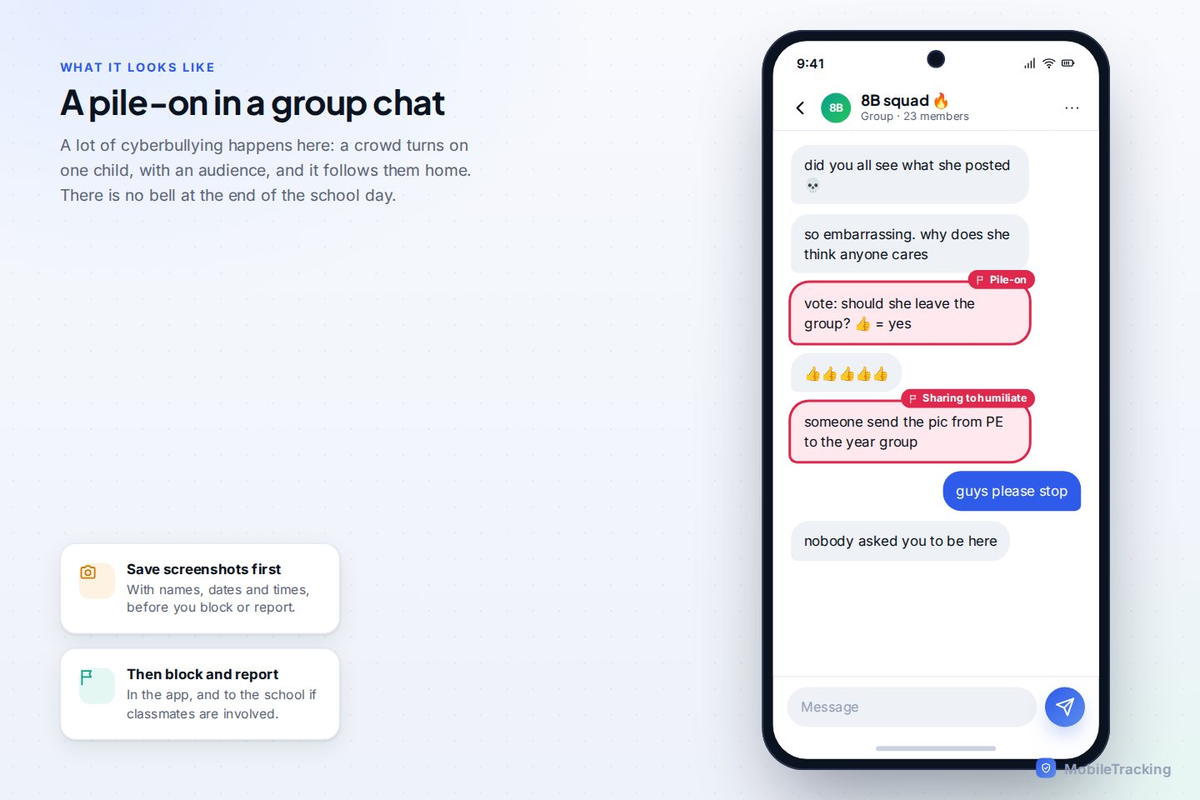
Two features make it especially painful, and worth understanding. It’s relentless: there’s no bell at the end of the school day when the bullying is on a phone. And it’s often public, or feels that way, the humiliation amplified by an audience of classmates, some of whom join in and most of whom just watch. For a child, that combination of inescapable and witnessed is uniquely crushing.
The warning signs
Children very rarely announce that they’re being bullied. They hide it, out of shame, out of fear it’ll get worse if they “tell,” and very often out of fear that you’ll respond by taking away the phone, which to them means taking away their whole social world. So you’re not waiting for a confession. You’re watching for changes.
- They seem upset, anxious or withdrawn after using their phone, and try to hide the screen when you come near.
- A sudden change in phone habits, either avoiding it entirely, or obsessive, anxious checking.
- Not wanting to go to school, or to see friends they used to be close to.
- Trouble sleeping, changes in appetite, or unexplained physical complaints like headaches and stomach aches that often turn out to be stress.
- Becoming secretive about their online life, or abruptly deleting accounts.
- A drop in grades, or losing interest in things they used to love.
Any one of these can be ordinary teenage weather. Several of them appearing together, especially alongside a change in mood, is worth a gentle, unpressured conversation, the kind that starts with “you’ve seemed a bit down lately, is everything okay?” rather than “is someone bullying you?”
What to do in the first 24 hours
When you find out, your instincts will be loud: confront the bully’s parents, march to the school, take the phone, fix it now. Slow all of that down. The first day is about your child, not about solving the problem, and getting the order right makes an enormous difference.
1. Stay calm and listen
Your reaction in this moment teaches your child whether it was safe to tell you, and whether they’ll tell you the next time. If you panic, get visibly angry, or immediately start firing off solutions, they learn to bring you less, not more. Lead with something like “I’m really glad you told me, and we’re going to get through this together.” Then let them talk, at their pace, without turning it into an interrogation. Your job in the first ten minutes is to be a safe place to land, nothing else.
2. Don’t take the phone away
It feels protective, but from your child’s side it lands as a punishment for being a victim. Worse, it teaches every kid watching, including your child’s siblings, that telling a parent about online trouble gets your phone confiscated, which guarantees the next kid stays quiet. It also cuts your child off from the friends who are their actual support system right now. Remove the harm, not the lifeline. There’s a difference, and it matters.
3. Save the evidence before anything gets deleted
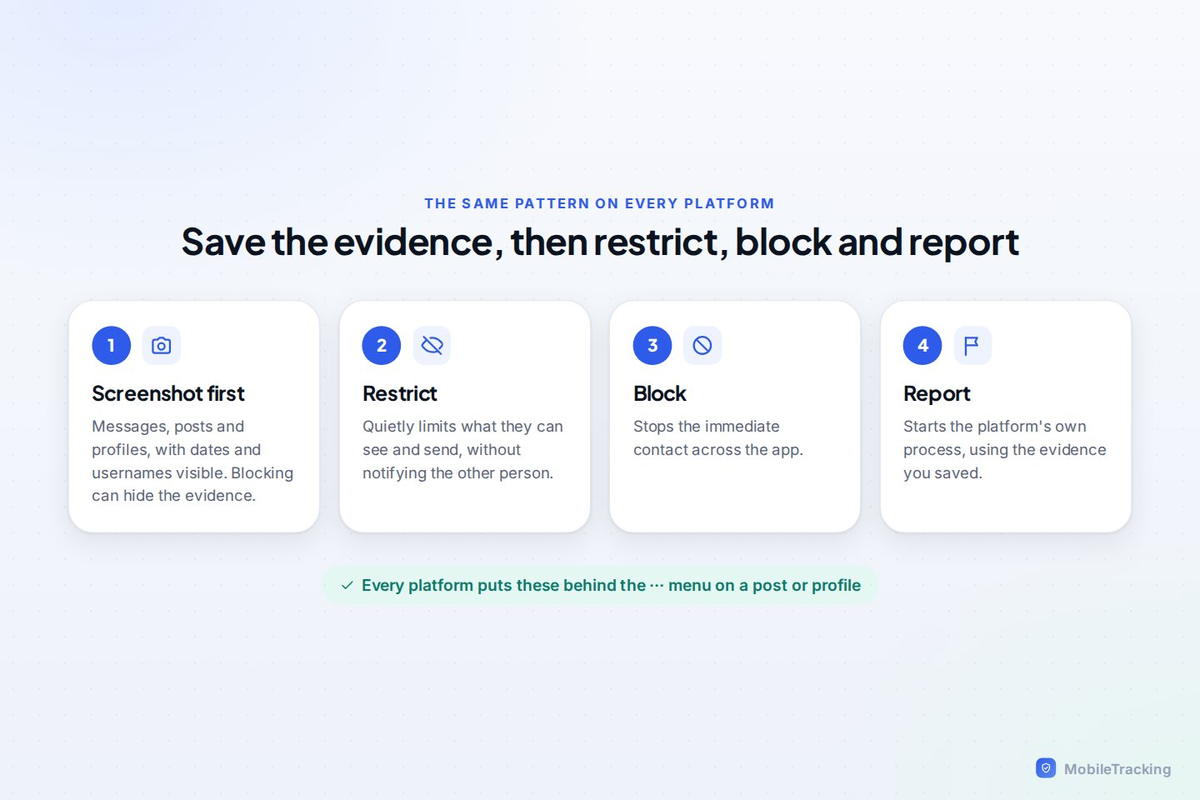
This is the single most practical step, and it’s easy to skip in the emotion of the moment. Take screenshots of the messages, posts, comments and profiles, with dates and usernames visible. Do this before you block or report anyone, because blocking can hide the evidence and bullies routinely delete things once they sense trouble. Schools and platforms will both ask for this, and having it ready turns a “he said, she said” into something concrete people can act on.
4. Block, then report
Once the evidence is safe, block the accounts involved and report the content to the platform. Blocking stops the immediate contact; reporting starts the platform’s own process. Do them in that order, evidence, then block, then report, so you don’t lose anything you’ll need later.
5. Tell the school if classmates are involved
Most cyberbullying is an extension of something already happening at school, and most schools now have both a duty and a policy to act, often even for incidents that technically happen off-campus, because they spill into the classroom. Bring your screenshots, ask what their process is, and keep a record of who you spoke to and when.
How to report on the major platforms
Every big platform has a reporting route, and they’re more alike than different. In general, tap the three-dot menu on a post, message or profile, choose Report, and pick harassment or bullying. A few platform-specific pointers:
- Instagram: report the post, comment or account. You can also “restrict” an account, which limits their ability to contact or see your child without notifying them, useful when you don’t want to escalate.
- TikTok: report the video, comment or account, block, and consider tightening who can comment on your child’s posts.
- Snapchat: press and hold a message, or open the profile, to report and block.
- YouTube: report the comment or video; on your child’s own channel you can hide a specific user’s comments.
- Games and Discord: report the user in-app and use the block or mute tools. On Discord, your child can also simply leave the server.
One important line: if any of it involves a credible threat of violence, or sexual images of a minor, treat it as an emergency and contact the police and your national reporting body, not just the platform. That’s beyond the reach of a Report button.
Helping your child recover
Dealing with the incident is not the same as helping the child, and the second part takes longer. Once the immediate steps are done:
- Keep checking in, over weeks, not just once. “How are things feeling today?” beats “is it sorted now?” Recovery isn’t a single conversation.
- Rebuild their world offline. Time with kind friends, a sport, a hobby, anything that reminds them they are more than the target of a group chat. The bullying tried to shrink their world; your job is to widen it again.
- Watch for lasting effects. Cyberbullying is linked to anxiety and depression. If low mood, withdrawal or hopelessness persists, involve your GP or a counsellor. And if you ever hear any talk of self-harm, treat it as urgent and seek help immediately, that’s not a wait-and-see situation.
- Say it again and again: it wasn’t their fault. Bullied kids very often come to believe they somehow deserved it or brought it on themselves. They didn’t, and they may need to hear that more times than feels necessary before it sinks in.
What if your own child is the one bullying?
It’s worth facing, because it’s more common than any parent wants to believe, and the online world blurs the line. A child can pile onto someone in a group chat without ever feeling like “a bully”, it’s just a joke, everyone’s doing it, the target isn’t even in the room. If you discover your child has been cruel online, respond firmly but without writing them off as a bad person. Help them genuinely understand the harm, have them take responsibility, including apologising where that’s appropriate, and look honestly for what’s driving it. Kids who bully are very often struggling with something themselves, and the behaviour is a symptom as much as a choice.
How monitoring helps, and where it stops
A parental control app can give you an earlier warning than you’d otherwise get, and earlier is everything with cyberbullying, because the hardest part is that kids hide it. Keyword alerts can flag when the language of bullying, self-harm or being targeted turns up in your child’s notifications, and unknown-contact flags can surface a stranger who’s suddenly piling on. That head start can mean the difference between catching something in week one and finding out in month three.
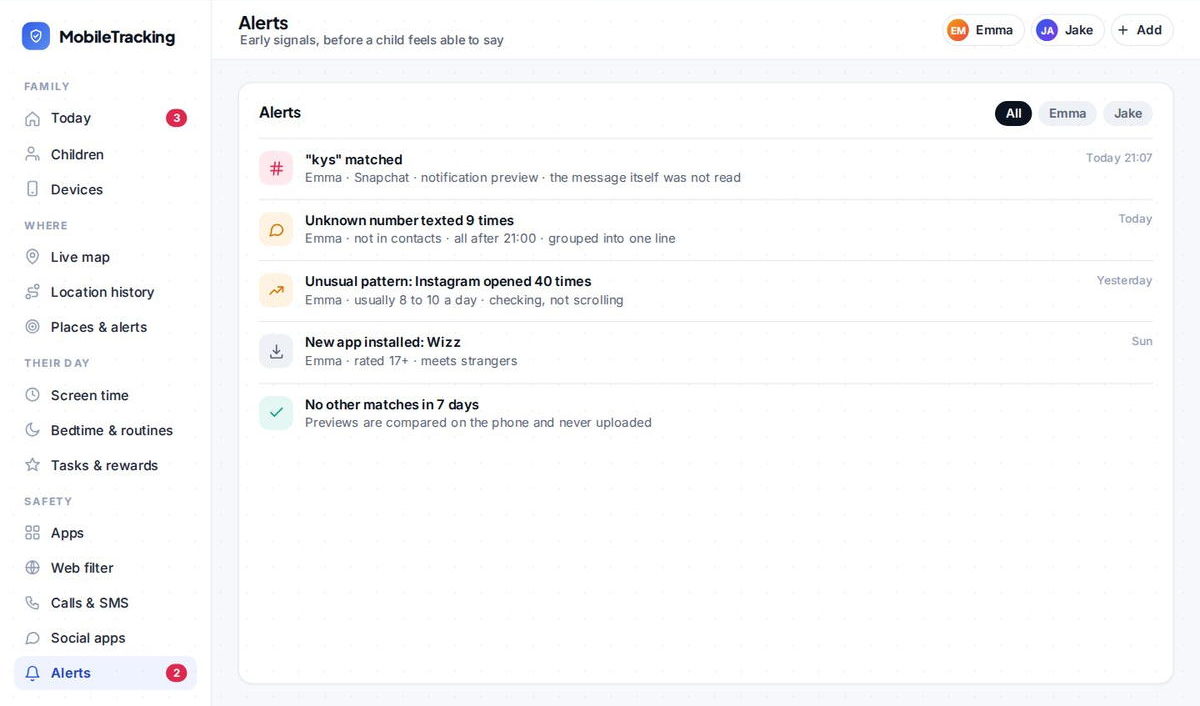
But be clear about the limit, because this is where over-trusting software goes wrong. No app can read the emotional weight of a message, judge whether teasing has curdled into cruelty, or replace the conversation where your child actually opens up and tells you what’s happening. Software can point you toward the problem sooner. What you do next, the listening, the calm, the standing beside them, is human, and it’s the part that actually heals it.
MobileTracking’s part in this
MobileTracking’s keyword alerts let you choose the words you’d never want to miss, the vocabulary of bullying, of self-harm, of being targeted, and tell you when one appears in a notification, without collecting the message itself. Unknown callers and contacts are flagged, so a stranger stands out from the normal traffic of friends. It’s an early-warning layer that works alongside the real work of staying close to your child, not a substitute for it.
Frequently asked questions
Should I contact the bully’s parents directly?
Sometimes it helps; just as often it inflames things and turns into a dispute between adults. Going through the school is usually calmer and more effective, because they can mediate and have a duty to act.
My child begged me not to tell anyone. What do I do?
Honour their fear by involving them in every step and agreeing together who to tell and how, but gently explain that keeping it completely secret is exactly what allows it to continue. The goal is to act with them, not behind them.
Is cyberbullying illegal?
Depending on where you live and what’s involved, threats, harassment, sharing intimate images, it can be a crime. Keep your evidence, and involve the police for anything threatening or sexual.
How do I stop it happening again?
Beyond blocking and reporting, tighten privacy settings so strangers can’t contact your child, teach them to save evidence and come to you early, and, most of all, keep the door open so that they do.
Should I contact the other child’s parents?
Sometimes, but tread carefully, and it often works better to go through the school than to approach the other family directly, especially at first. A parent-to-parent confrontation can escalate quickly and put the other parent on the defensive, whereas the school can address it more neutrally and has a duty to act. If you do reach out, stay calm and factual rather than accusatory, and preserve the evidence either way, since it matters whichever route you take.
Will reporting it make the bullying worse?
It is a common fear, and one reason children beg parents not to tell anyone, but staying silent lets the bullying continue unchecked. A good school handles a report discreetly and with an eye to preventing retaliation. Involve your child in decisions about what happens next so they feel some control, reassure them that adults can act without making things worse, and keep supporting them throughout, which matters more than any single step you take.
Note: this article touches on distressing subjects. If your child is in crisis or is talking about self-harm, contact your local emergency services or a dedicated helpline right away. That matters more than anything you can do on a phone.
Keep going
Read our guides on the social apps teens actually use, AI chatbots and kids, and transparent monitoring for families. For trusted guidance beyond this site, Common Sense Media is a well-regarded resource for parents: Common Sense Media.