Most family rules about phones exist only in a parent’s head, which is exactly why they cause so many arguments. The limit is whatever you decide it is in the moment, the consequences appear out of nowhere, and every evening becomes a fresh negotiation because nothing was ever actually agreed. A family media agreement fixes this by doing something simple and surprisingly powerful: it writes the rules down, and it gets everyone to agree to them together, in advance, when nobody is upset.
This is not about drawing up a legal contract or turning your home into a bureaucracy. It is about replacing a running series of ad-hoc battles with one shared, visible understanding of how screens work in your family. This guide explains why the approach works so well, walks through what to put in one, and gives you a ready-to-adapt template you can have on the fridge by this evening.
Why a written agreement beats rules in your head
The magic of a family media agreement is not really the document; it is what making it does. Three things change the moment rules move from your head onto paper.
First, it removes ambiguity. “Not too much screen time” means one thing to you and something very different to your child, and that gap is where every argument lives. A written “one hour on school days, agreed together” leaves nothing to interpret in the heat of the moment. Second, it creates buy-in. A rule handed down from above invites resistance; a rule a child helped write, and put their own name to, is one they feel some ownership of, and children keep the rules they helped make far better than the ones imposed on them. Third, it makes consequences fair and predictable. When everyone agreed in advance what happens if a limit is broken, enforcing it stops feeling like a personal attack and starts feeling like simply following the deal, which takes the emotional heat out of the whole thing.
Put together, the agreement shifts you from being the moment-to-moment enforcer, the one who has to decide and impose everything on the spot, to being the person who helps the family keep to something everyone signed up for. That is a much easier and much less adversarial role to play.
The golden rule: it applies to everyone
Before the specifics, the most important principle: a family media agreement is for the whole family, adults included. This is not negotiable if you want it to work.
Children have a finely-tuned radar for hypocrisy, and nothing undermines a screen rule faster than a parent who enforces “no phones at dinner” while scrolling under the table. Beyond fairness, including yourself models exactly the behaviour you are trying to teach: that everyone, whatever their age, benefits from boundaries around screens, and that managing a phone’s pull is a lifelong skill, not a childish limitation. When the grown-ups visibly follow the same rules, no phones at meals, phones charging downstairs overnight, the whole thing stops being a punishment aimed at children and becomes simply how this household does things. That framing is worth more than any specific rule in it.
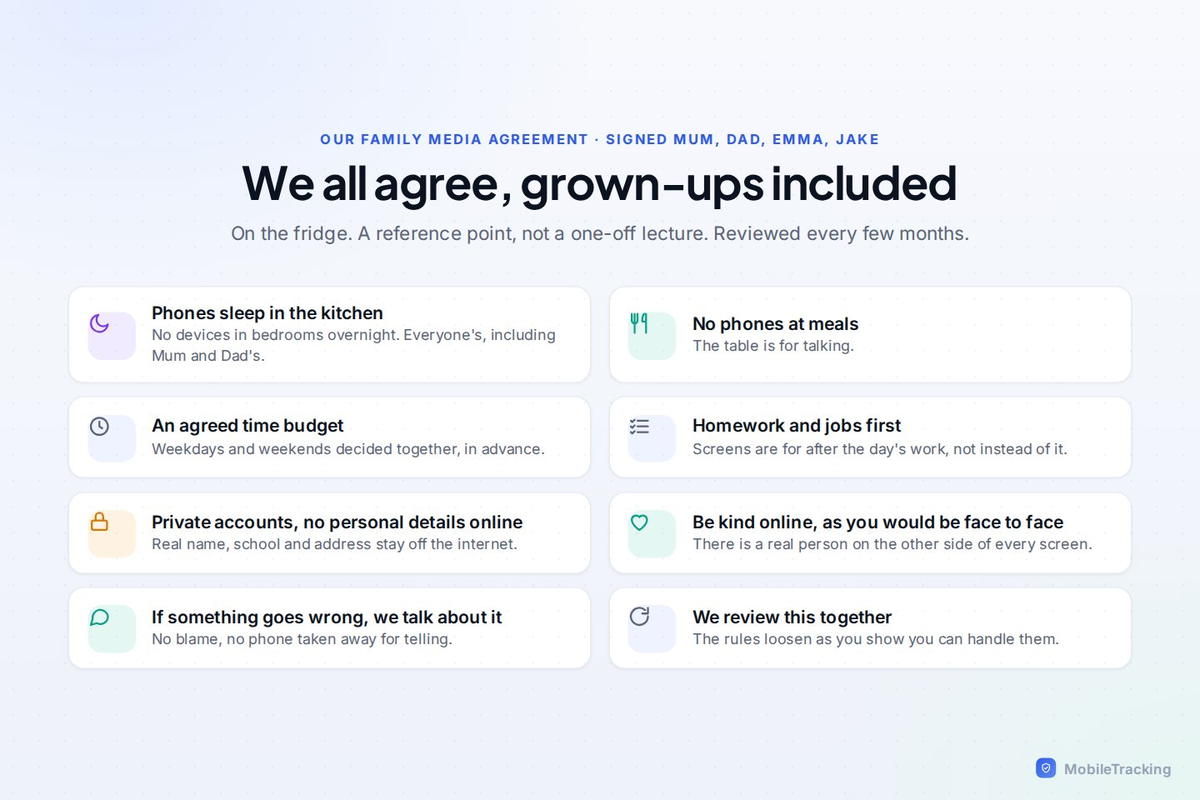
What to put in it
A good agreement covers a handful of areas. You do not need all of these, and you should phrase them in your own family’s words, but these are the categories worth thinking through.
Where and when phones are used. The highest-value entries live here: no devices in bedrooms overnight (they charge in a shared spot), no phones at meals, and screens off for a while before bed. These are the rules with the biggest payoff, especially the overnight one, which protects sleep.
How much time. An agreed daily or weekly budget, sensibly different for school days and weekends, so the amount is settled in advance rather than argued nightly. Deciding the number together is what makes it stick.
What comes first. The order of the day, homework, jobs, and other commitments before recreational screens, so the phone is a reward for the day’s work being done, not a competitor with it.
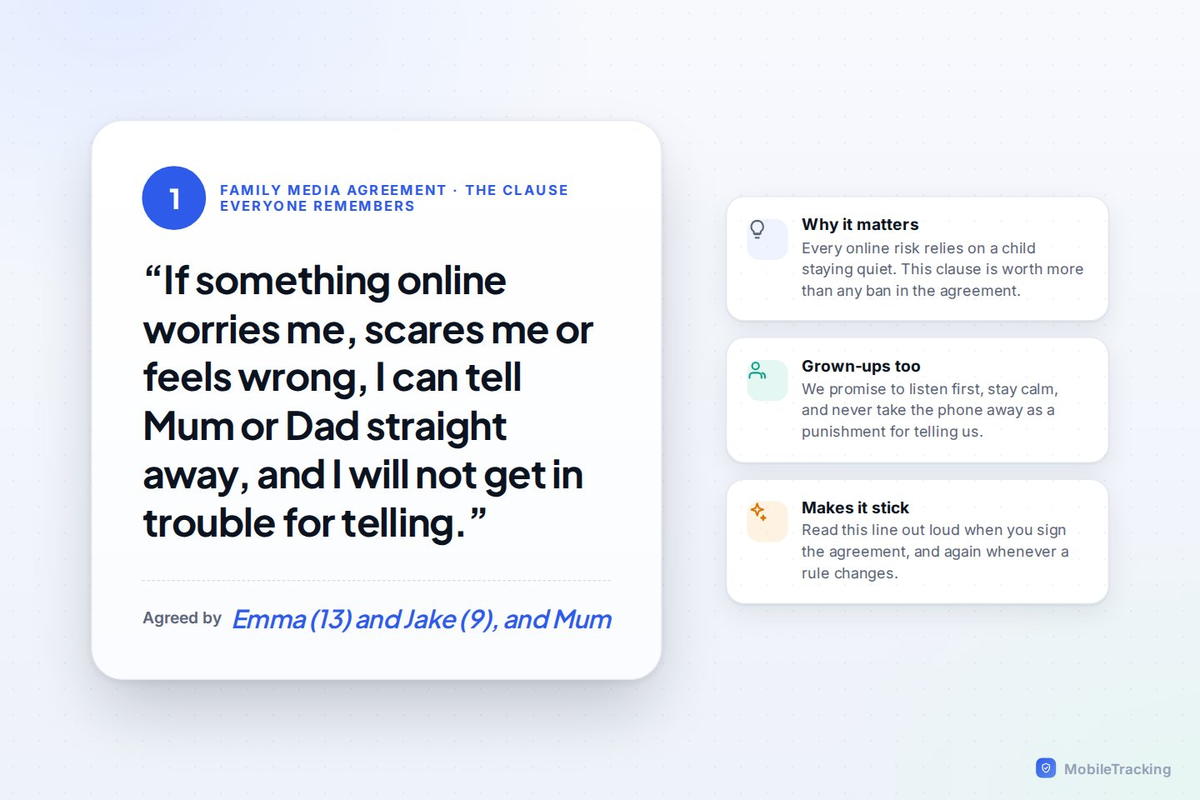
Behaviour and safety. The promises about how to act online, being kind, not sharing personal details or photos without checking, and, most importantly, the standing agreement that a child can always come to a parent if something online worries or upsets them, without getting in trouble. This last one is the single most protective line in the whole document.
Consequences. What happens if the agreement is not kept, decided calmly in advance so it is predictable and fair rather than invented in anger. Keep these proportionate and, ideally, natural, more time earned back by keeping to the deal, rather than dramatic confiscations.
A ready-to-use template
Here is a straightforward version to adapt. Change the wording, the times, and the specifics to fit your family and your children’s ages, then write it out (or type and print it), have everyone read it, and sign it together. The act of signing matters more than it sounds; it turns a lecture into a shared commitment.
Our Family Phone Agreement
- Phones sleep downstairs. No devices in bedrooms overnight. They charge in the kitchen, grown-ups’ phones too.
- Screens off at meals. No phones at the table, for everyone.
- Homework and jobs first. The phone waits until schoolwork and chores are done.
- Agreed time limits. We set the daily limit together, and I’ll stick to it. (Write your numbers here: e.g. one hour on school days, longer at weekends.)
- I’ll come to you. If anything online worries, scares, or upsets me, I’ll tell a parent, and I won’t be in trouble for telling.
- Be kind online. I’ll treat people online the way I would face to face.
- Ask before I share. No photos, videos, or personal details posted without checking first.
- Grown-ups follow it too. Parents keep the same rules. This goes both ways.
- If the deal isn’t kept (agree this together, and keep it fair and predictable).
Signed: ________________ (child), ________________ (parent), Date: __________
Common mistakes that make agreements fail
Plenty of families write an agreement full of good intentions and find it quietly forgotten within a fortnight. A few predictable mistakes are usually to blame, and they are easy to avoid once you know them.
The first is making it too long and too strict. An agreement with thirty rules and harsh penalties reads as a charge sheet, and no one keeps it. A short list of the things that genuinely matter, held consistently, beats an exhaustive one that collapses under its own weight. The second is writing it at children rather than with them, especially older ones; a document handed to a teenager to sign, with no input, invites the very rebellion it was meant to prevent. The third is inconsistency, from the parents most of all: a rule enforced on Monday and ignored on Wednesday teaches a child that the whole thing is optional. The fourth is treating it as permanent, so it quickly stops matching a growing child’s life and becomes irrelevant. And the fifth is the sneaky one, framing it entirely as a list of bans, which makes screens feel like forbidden fruit rather than one enjoyable part of a balanced life. Aim for short, shared, consistent, evolving, and positive, and the agreement will still be doing its quiet work months later.
Make it fit the age, and expect it to change
An agreement written for an eight-year-old should not be the same one you use with a fifteen-year-old, and saying so out loud helps. For younger children, keep it short, simple, and mostly about where and when devices are used; a few clear picture-book rules are plenty. For tweens and teenagers, involve them much more in writing it, take their views seriously, and build in the idea that freedoms expand as they show they can handle them. An older teen who has genuine input into the agreement, and who can see a path to fewer restrictions, is far more likely to respect it than one handed a document to sign.
Crucially, treat the agreement as a living thing, not a stone tablet. Revisit it every few months, or when circumstances change, a new phone, a new app, a birthday, and adjust it together. Loosening a rule because your child has earned it is one of the most powerful trust-building moves you can make, and it keeps the agreement feeling fair rather than fixed. The document is really just a structured way of having the ongoing conversation that good digital parenting requires, and the conversation matters more than any single clause in it.
How to actually make it work
A few practical notes separate the agreements that stick from the ones that end up forgotten in a drawer. Do it at a calm time, not in the middle of a screen-time row, so it is a positive family project rather than a punishment. Keep it visible, on the fridge or a noticeboard, so it is a shared reference everyone can point to, not something invoked only when you are cross. Frame the whole thing positively, as how your family enjoys the good parts of technology while protecting the things that matter, sleep, meals, time together, rather than as a list of bans. And follow it yourself, visibly and consistently, because your example is the single biggest factor in whether your children take it seriously.
A note on MobileTracking
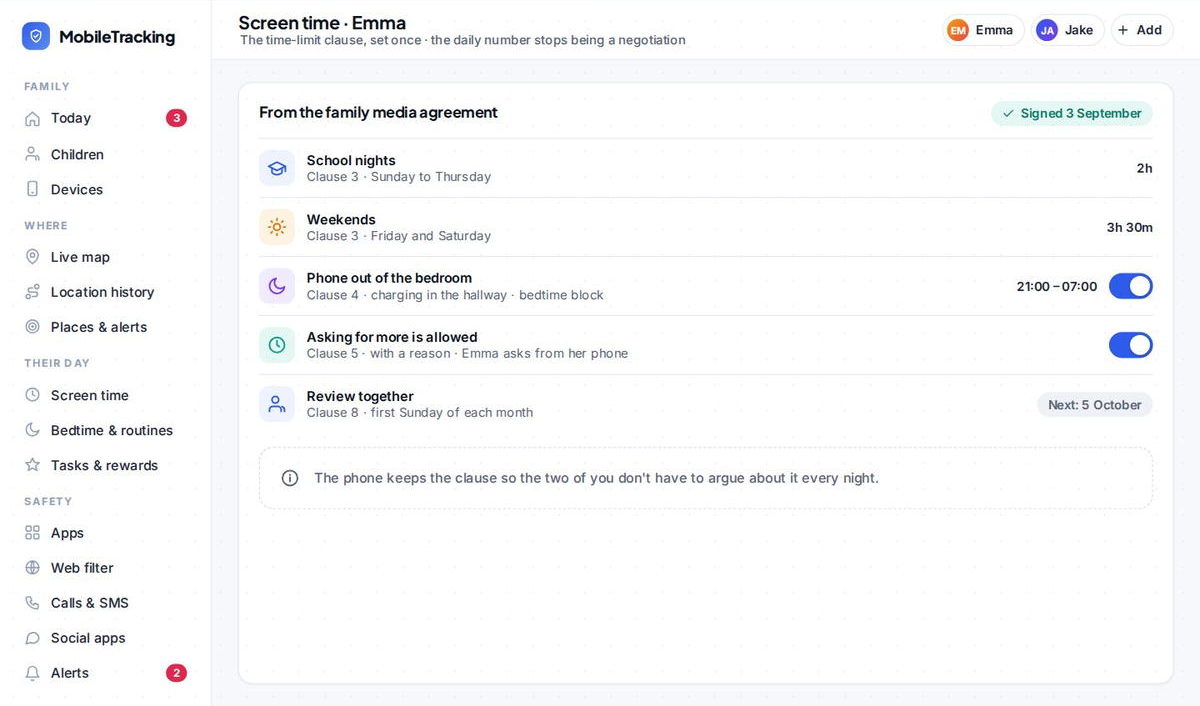
MobileTracking helps you put the agreement into practice, so the rules you have written down are actually supported by how the phones work. You can set the agreed daily time limits and a bedtime block that matches the “phones sleep downstairs” rule, filter content in line with what you have agreed is appropriate, and keep an eye on whether the arrangement is holding, all in a way your child can see. Because it is transparent and visible on the child’s phone, it fits the spirit of a shared agreement rather than working against it: the document sets out the promises, and the app quietly helps everyone keep them.
Frequently asked questions
What is a family media agreement?
It is a written set of rules about how screens and phones are used in your household, agreed and signed by the whole family together. It replaces vague, in-your-head rules and nightly negotiations with one clear, shared understanding, covering things like where phones are used, time limits, online behaviour, and what happens if the agreement is not kept.
Why write the rules down instead of just having them?
Writing them down removes the ambiguity that causes most arguments, creates buy-in (children keep rules they helped make far better than ones imposed on them), and makes consequences predictable and fair rather than invented in the heat of the moment. It also shifts you from being the constant enforcer to helping the family keep to something everyone agreed.
Should the rules apply to parents too?
Yes, and this is essential. Children spot hypocrisy instantly, and nothing undermines a screen rule faster than a parent breaking it. Including yourself models the behaviour you want to teach and turns the agreement from a punishment aimed at children into simply how the whole household does things, which is far easier to sustain.
What age should we start a family media agreement?
You can start as soon as a child uses devices, keeping it very simple for young children and involving older ones much more in writing it. The best moment to introduce or update one is when a child gets a new phone. Treat it as a living document you revisit and adjust as they grow and earn more freedom.
What should happen if my child breaks the agreement?
Decide the consequences together, in advance, and keep them fair, proportionate, and predictable, ideally natural ones like earning time back by keeping to the deal, rather than dramatic confiscations invented in anger. The point of agreeing consequences beforehand is that enforcing them stops feeling like a personal attack and simply becomes following the deal everyone signed.
Keep going
Read our guides on how to tell your child you’re monitoring their phone, how much screen time is healthy by age, and cutting screen time without a fight. For trusted guidance beyond this site, Common Sense Media is a well-regarded resource for parents: Common Sense Media.