Fortnite occupies a strange place in the parent imagination. It is the game blamed for everything, the one relatives tut about, the one that supposedly turns children into twitchy, hyperactive strangers who rage-quit and beg for money. Some of that reputation is earned and some of it is nonsense, and the useful thing a parent can do is tell the two apart. Because once you look past the noise, Fortnite safety is quite manageable, a small number of real considerations, all of which have settings.
Here is the honest summary before the detail. The violence is cartoonish and bloodless, closer to a water-pistol fight than anything graphic, which is why the game carries a rating around age twelve rather than an adult one. The genuine things to manage are three: voice chat with strangers, spending on V-Bucks, and the game’s frankly excellent ability to hold your child’s attention for hours. Handle those three and Fortnite becomes, for most families, a perfectly reasonable thing to allow.
What Fortnite actually is
At its core, Fortnite is a “battle royale”: a hundred players drop onto an island and fight to be the last one standing, building walls and ramps as they go. Matches are short and punchy, usually under twenty minutes, which is part of why it is so easy to say “just one more”. Over the years it has grown into more than that, with a creative mode, live in-game events and concerts, and a rotating cast of collaborations, but the battle royale is the heart of it.
The violence, and this matters for the age question, is deliberately unrealistic. Characters are colourful and stylised, there is no blood, and defeated players simply vanish and respawn into the next match. It is competitive and it can be intense, but it is not gory. This is why classification bodies land it around a twelve rating: appropriate content-wise for most secondary-school-age children, and a judgement call for younger ones based on the individual child.
The real issue number one: voice chat
If there is a single thing to sort out in Fortnite, it is voice chat. Because the game is team-based, children very often play with a headset on, talking live to their squad. When that squad is their real-life friends, this is lovely, genuinely social, cooperative, full of laughter. When the game fills empty squad slots with random strangers, that same open microphone becomes a channel to anyone, of any age, saying anything.
Two problems come out of open voice chat with strangers. The milder one is exposure to bad language, aggression, and the general toxicity of competitive online play, which can be a lot for a younger child. The serious one is the same pattern that runs through every online game: an adult using the friendly, trusting environment to build a rapport with a child and then steer them somewhere private. Voice is a particularly intimate channel for this, which is exactly why it deserves the most attention.
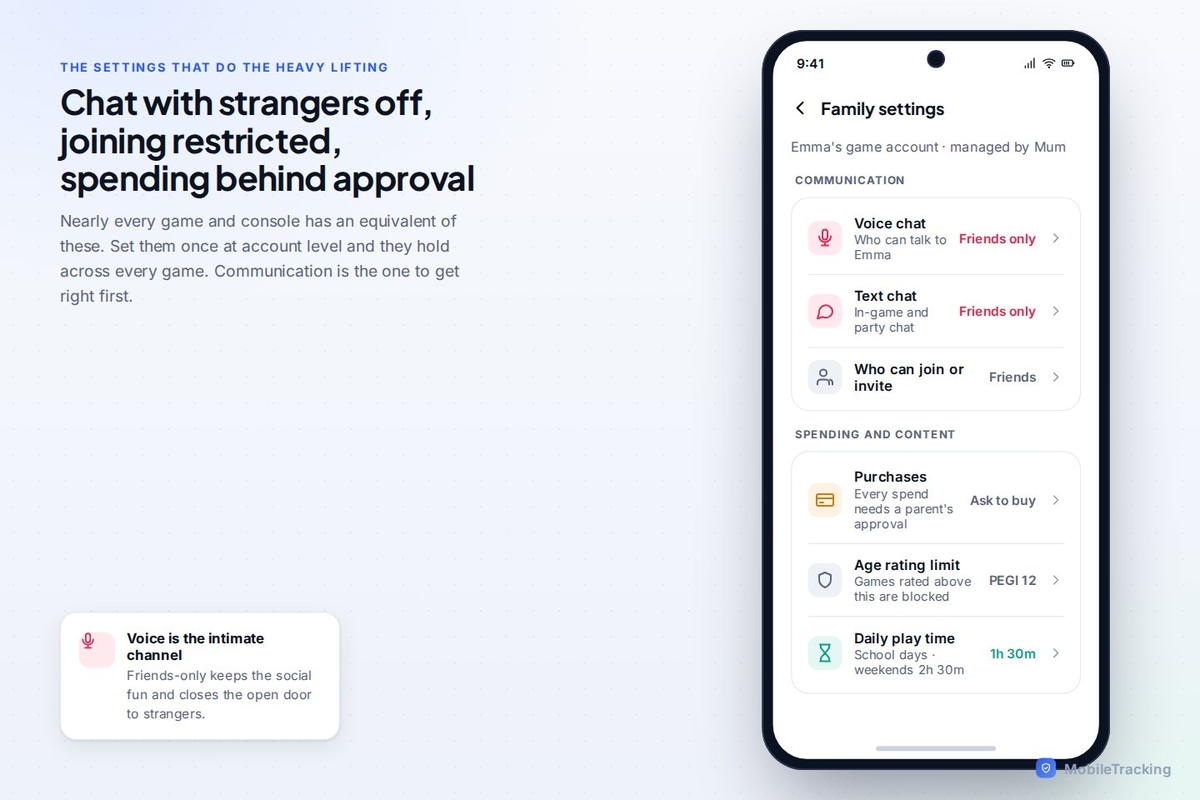
The fix is straightforward. In Fortnite’s audio and account settings you can restrict voice chat, set it so your child only talks to friends they have added, or turn it off entirely for younger players. For a child playing mainly with school friends, “friends only” is often the right balance: they keep the social fun with people they know, and the open door to strangers is closed. Teach the universal rule alongside it, never move a conversation to another app, never share personal details with someone met in-game, and you have covered the risk that actually matters.
The real issue number two: V-Bucks and the pressure to spend
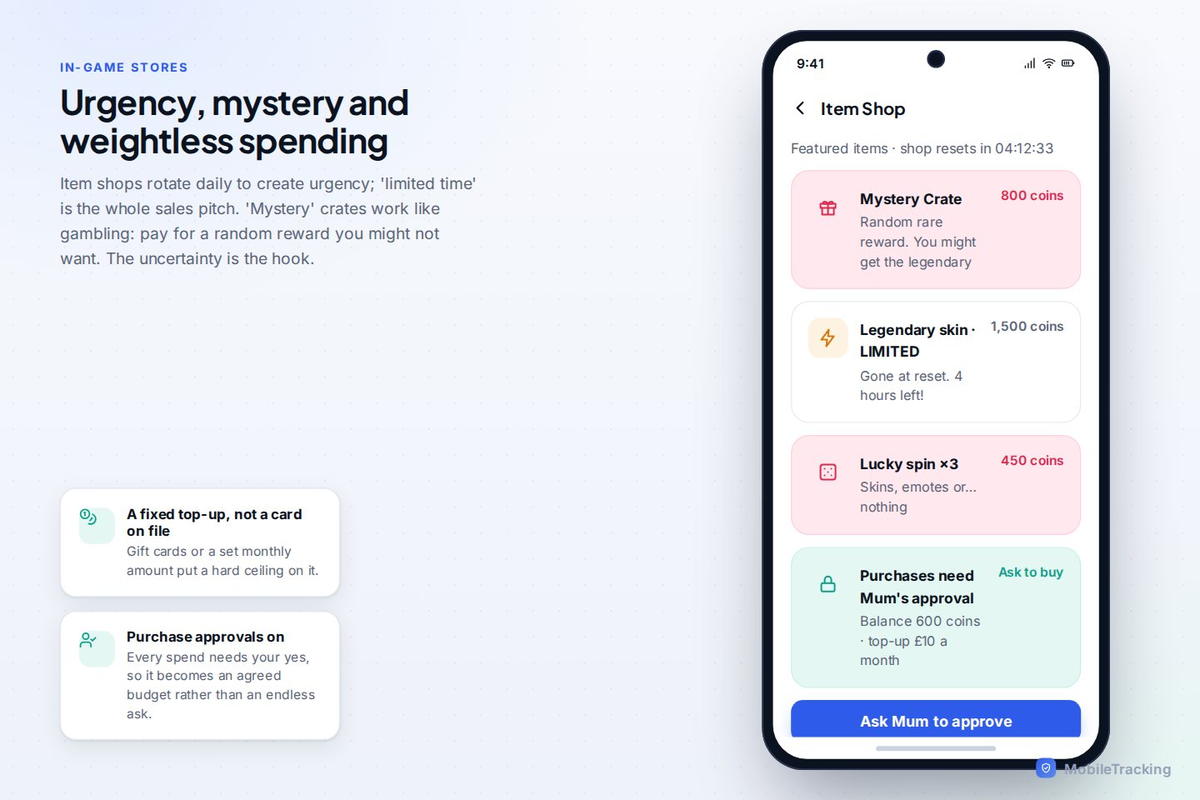
Fortnite is free to play, which is precisely why spending is a live issue: the business model is built on selling things inside a free game. The currency is V-Bucks, bought with real money and spent on cosmetic items, outfits (known as “skins”), dance moves (emotes), and the “Battle Pass”, a seasonal set of rewards you unlock by playing.
Importantly, and this is a point of fairness to the game, none of these purchases make you better at Fortnite. They are cosmetic. You cannot buy power or wins. But do not underestimate the social pressure a child feels around them: skins and emotes are status symbols among kids, the rough equivalent of trainers in a playground, and a child can feel genuinely left out for wearing the free “default” outfit. That pressure is real even though the items are, objectively, just decorations.
The money management is the same as for any game with a store. Do not leave a payment card sitting on the account for a child to spend from freely; buy V-Bucks deliberately, in set amounts, using gift cards or a controlled top-up, so there is a hard ceiling. Turn on purchase approvals in your family payment settings so every spend needs your yes. And it is worth a gentle conversation about the skins-as-status thing, not to dismiss how your child feels, but to put it in perspective and agree a sensible budget together rather than fighting about each individual purchase.
The real issue number three: it is built to keep them playing
This is the one relatives complain about, and they are not entirely wrong. Fortnite is engineered, skilfully and deliberately, to keep players coming back. Short matches mean there is always time for one more. The Battle Pass rewards you for playing every day. Seasons change, limited-time items rotate through the shop to create urgency, and live events give kids a fear of missing out if they are not on at the right moment. None of this is accidental; it is good game design pointed squarely at engagement.
The result is that Fortnite can genuinely eat an evening, and children can get properly upset when told to stop, partly because they are often mid-match and quitting lets their team down, and partly because the game is designed to make stopping feel like a loss. Understanding that this is by design, not your child being difficult, helps you respond to it calmly.
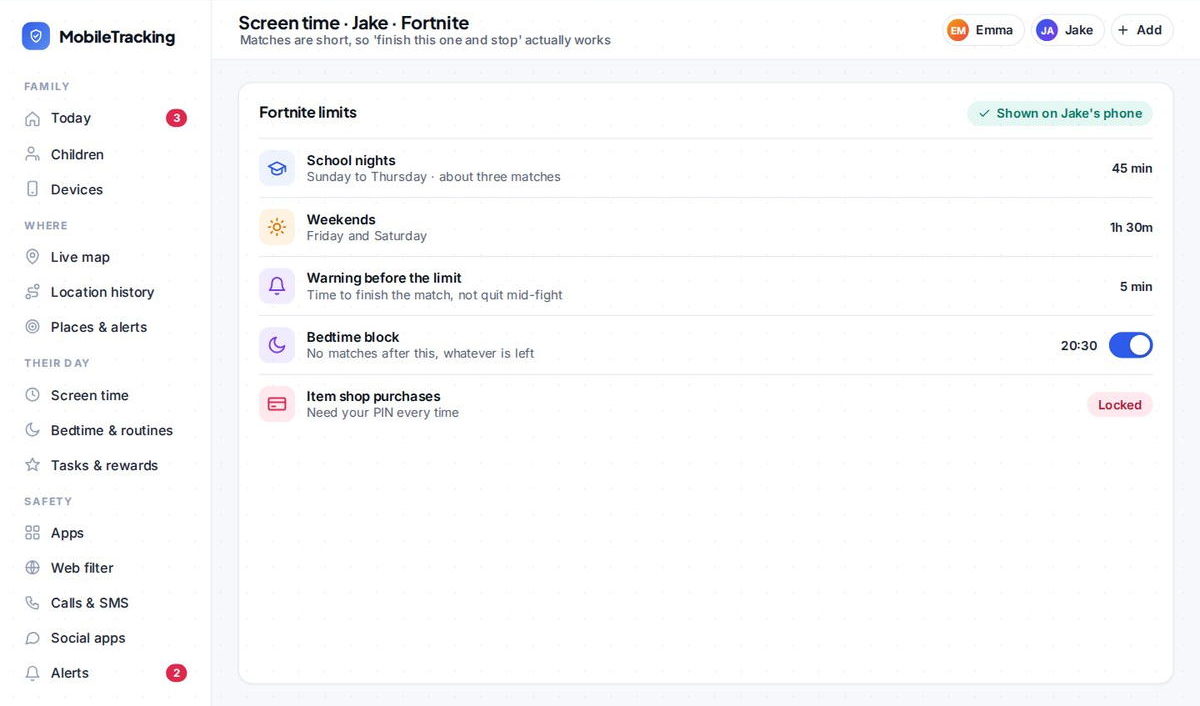
The practical answer is a visible, agreed time budget rather than a surprise cut-off, with a warning before the end so they can finish the current match rather than abandoning their squad. Fortnite matches are short, so “finish this game and then we’re done” is a reasonable and enforceable deal in a way it is not for an open-ended game. The device’s screen-time controls or a family app let you set the overall budget so it lands consistently and is not renegotiated every single night.
The “rage” question, and what is really going on
Parents often worry about the anger Fortnite seems to produce: the shouting, the controller-throwing, the foul mood after a bad match. It is worth understanding, because the game itself is not turning your child into an angry person. Competitive games produce strong emotions, you invest twenty minutes, get close to winning, and lose at the last moment, and that stings, especially for a child still learning to regulate frustration.
The unhealthy pattern is not feeling frustrated; it is having no way to manage it and no boundary around it. So the useful responses are about emotional coaching and structure rather than banning the game: talking about handling losing, not playing when already tired or wound up, keeping it out of the hour before bed so a bad match does not become a bad night’s sleep, and modelling that it is only a game. A child who plays Fortnite within sensible limits and can lose a match without it ruining the evening is doing fine. The one to watch is the child for whom every session ends in a meltdown, which is usually a sign the limits, or the timing, need adjusting.
Beyond battle royale: creative mode and the wider world
It is worth knowing that Fortnite is no longer just the fighting game, because your child may be spending time in parts of it you have not seen. There is a creative mode, and a huge library of user-made islands and mini-games built by other players, ranging from obstacle courses and hide-and-seek to racing and role-play. Much of this is tamer than the battle royale and genuinely creative, which is good, but it carries the same underlying point as Roblox: when the content is made by anyone, quality and appropriateness vary, and the chat still connects your child to other players.
Fortnite has also become a kind of social space in its own right, hosting live in-game concerts and events that draw millions of kids at once. These are usually harmless spectacles, but they create their own fear-of-missing-out pressure, “everyone will be on tonight”, which is worth being aware of when your child suddenly needs to play at a very specific time. None of this changes the core advice; it just means the settings you put in place, chat restrictions, spending limits, and a time budget, apply across the whole of Fortnite, not only the shooting.
A sensible Fortnite safety setup
Put together, a good Fortnite safety configuration looks like this. Set up your child’s account under your family group so you have control over the settings and spending, and note that Epic uses a “Cabined Account” with extra restrictions for younger children until a parent gives consent. Restrict voice and text chat to friends only, or off for younger players, so the stranger risk is closed. Buy V-Bucks in deliberate, capped amounts and turn on purchase approvals. Agree a daily or weekly time budget and enforce it with a warning and an end-of-match cut-off rather than a mid-game yank. And keep the stranger-safety conversation live, because it is the habit that protects them across every game, not just this one.
Do that, and Fortnite stops being the bogeyman and becomes what it mostly is for the children who play it well: a fast, social, genuinely fun game they play with their friends, inside limits everyone understands.
Where a tool like MobileTracking helps
MobileTracking sits alongside Fortnite’s own settings, not on top of them. It shows how much time Fortnite and other games are taking so the balance stays sensible and a sudden spike is easy to spot, flags when a new chat app appears on the phone (worth knowing, since the classic risk is a stranger moving your child from voice chat to a private messenger), and lets you set a whole-phone screen-time budget that covers gaming along with everything else. It gives you a light, early view of the overall picture, underneath the Fortnite-specific setup and the conversations that do the real work.
Frequently asked questions
What age is Fortnite suitable for?
Fortnite carries a rating around age twelve, reflecting its cartoonish, bloodless violence rather than anything graphic. It suits most secondary-school-age children content-wise, and is a judgement call for younger ones. The bigger factors than the violence are voice chat, spending, and time, all of which you can control.
Should I turn off voice chat in Fortnite?
For younger children, yes, or restrict it to friends only. Open voice chat with random strangers is the main risk in Fortnite, both for exposure to toxicity and as a channel a bad actor could misuse. Friends-only voice keeps the social fun with people your child knows while closing the door to strangers.
Do V-Bucks purchases make you better at the game?
No. Everything you buy in Fortnite is cosmetic, outfits, dances, and the Battle Pass. You cannot buy power or wins. The pressure to spend is social, skins are status symbols among kids, so the answer is a capped budget and purchase approvals rather than worrying that not spending puts your child at a disadvantage in play.
Why does my child get so angry playing Fortnite?
Competitive games produce strong emotions, and losing a close match after twenty minutes genuinely stings. The game is not making your child an angry person; the fix is emotional coaching and structure, talking about losing, not playing when tired, and keeping it away from bedtime, rather than banning it. Persistent meltdowns usually mean the limits or the timing need adjusting.
How do I stop Fortnite taking over every evening?
Set an agreed daily or weekly time budget and enforce it with a warning plus an end-of-match cut-off, matches are short, so “finish this one and stop” works. The game is deliberately built to keep players coming back, so a consistent, visible limit, backed by the device’s screen-time tools or a family app, works far better than a nightly argument.
Keep going
Read our guides on Roblox safety, Minecraft safety, and cutting screen time without a fight. For trusted guidance beyond this site, ESRB is a well-regarded resource for parents: ESRB.