Parents want a number. “How many hours a day is okay?” is one of the most-searched questions about screen time by age, and it’s completely understandable, a clear limit feels manageable. But any guide that hands you a single figure and calls it a day is doing you a quiet disservice, because the number turns out to be the least important part of the answer.
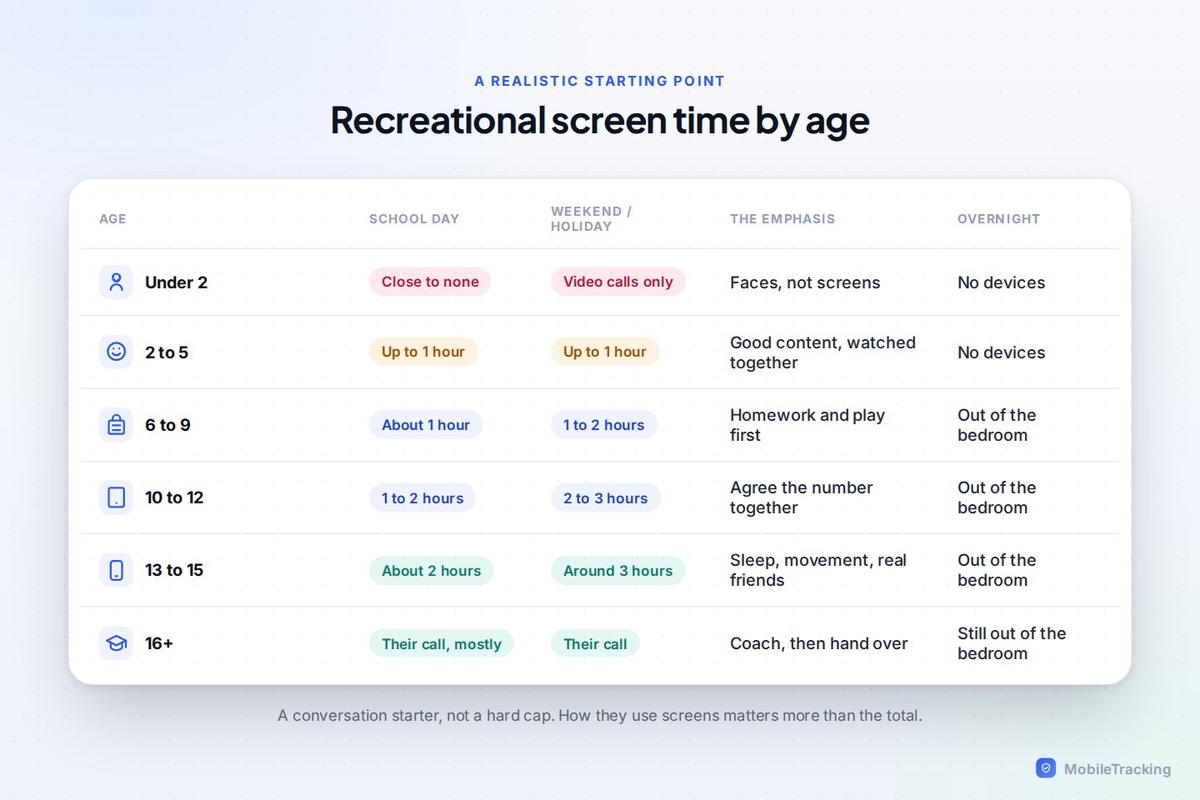
Here’s a rough, widely-used starting frame anyway, because you asked: close to none under two; up to about an hour of good-quality content for preschoolers; one to two hours of recreational screen time through the primary-school years; and a gradual loosening through the teens, where the emphasis shifts from counting minutes to protecting sleep, movement and real-world connection.
That’s the short version. The rest of this guide is the part that actually helps, because how your child uses screens matters far more than the total on a timer, and understanding that will make you a better judge of your own kid than any chart could.
Why screen time by age matters less than you think
Consider two children, each with exactly two hours of screen time today. The first spends it on a video call with grandparents, a coding project, and a nature documentary they then chatter about at dinner. The second spends it alone in their room, thumb flicking upward through an endless feed, feeling a little worse with each swipe. Same number. Utterly different effect on a developing human.
This is why researchers increasingly talk about the “three Cs” rather than a stopwatch. There’s the content: is it age-appropriate, active and worthwhile, or is it junk? There’s the context: is your child alone in a bedroom at midnight, or in the living room where you can see and share it? And there’s the child, because the same hour affects an anxious, sensitive kid differently from an easy-going one. A raw number ignores all three, which is why two families can hit the identical figure and get opposite results.
So use the screen time by age guides below as a floor to build sensible habits on, not a rule to enforce to the minute. The goal isn’t to win a stopwatch battle. It’s to raise a kid with a healthy relationship to their screens.
Ages 0-2: as close to none as you can manage
For babies and toddlers, the guidance sits close to zero, with the sensible exception of video calls with family, which are genuinely social. The reasoning is developmental, not moralistic: very young children learn from real faces, real objects, and real back-and-forth, and a screen at this age tends to displace exactly the play and interaction that build the brain. If screens are used at all, keep it brief, high-quality, and watched together, so it’s a shared thing rather than a babysitter. And keep the child’s own devices out of the picture entirely at this age, there’s simply no version of a tablet a one-year-old needs.
Ages 2-4: up to about an hour, watched together
Preschoolers can handle a bit more, a rough ceiling of around an hour a day of genuinely good content. The word that carries all the weight here is together. A three-year-old parked alone with a tablet gets very little from it; the same three-year-old watching alongside a parent who talks about what’s happening, “look, what do you think he’ll do next?”, is getting language, attention and connection out of the same show. That co-viewing is where nearly all the value at this age lives. Content that’s slow, simple and interactive beats fast, flashy and passive, every time.
Ages 5-8: one to two hours, with the habits that will matter later
As kids start school, one to two hours of recreational screen time a day is a reasonable frame, kept separate from anything schoolwork requires. But the specific number matters less than the habits you set now, because these are the ones you’ll be grateful for at fourteen. No screens at meals. No screens in the hour before bed. Screens out of the bedroom overnight. Habits established gently at six are worth ten times more than rules fought over at fourteen, when the stakes and the resistance are both much higher. Start them while they’re easy.
Ages 9-12: the tween shift from “how long” to “what and why”
This is where it gets genuinely harder. Phones arrive, group chats start, social pressure ramps up, and a flat time limit starts to feel arbitrary to a child who’s beginning to reason about fairness. Keep a budget, a couple of hours of recreational screens on a school day, more at the weekend is a common shape, but start shifting the conversation from “how long were you on it” to “what were you doing, and how did it make you feel.”
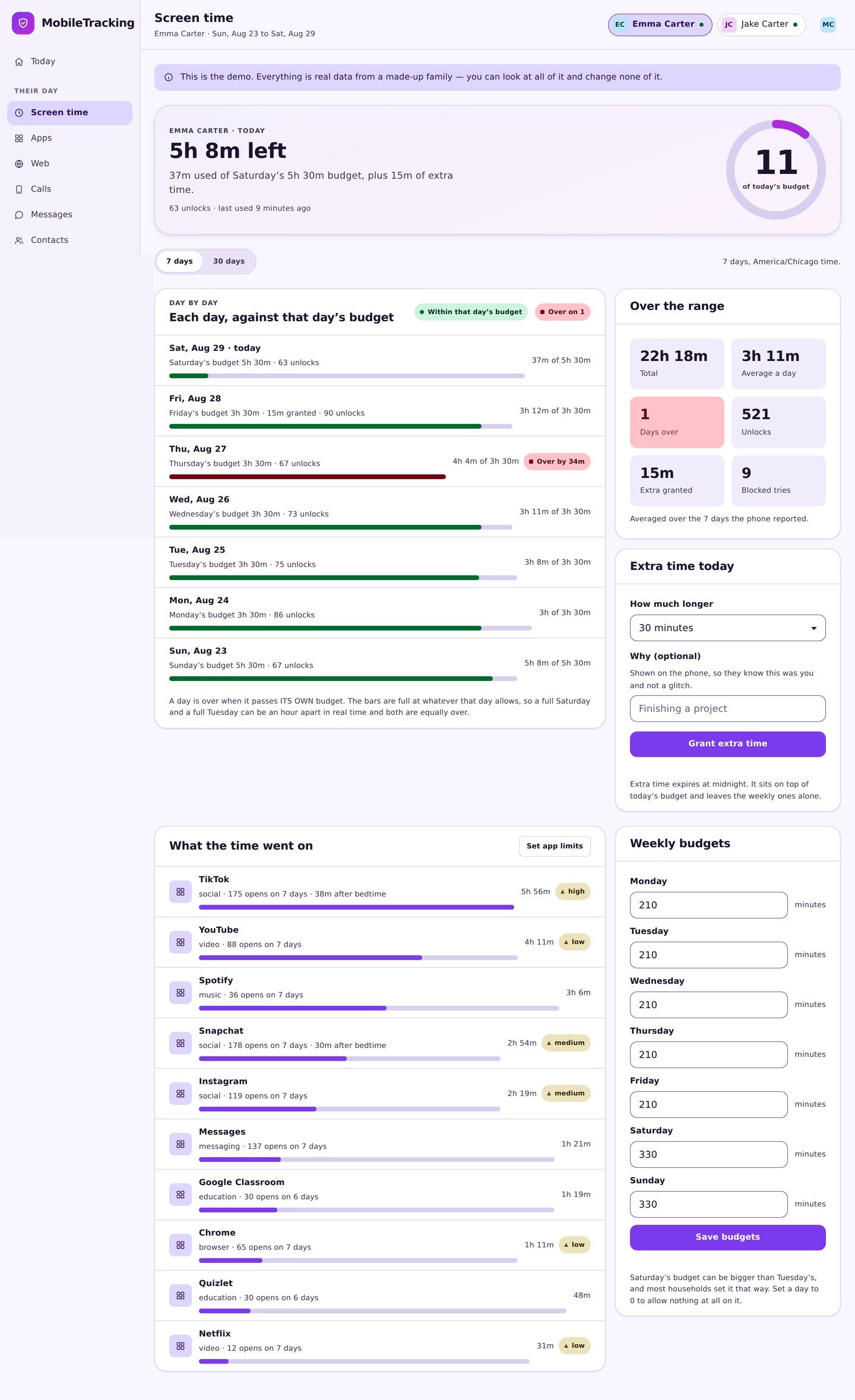
This is also the age where a family media plan, written together, starts to outperform a rule handed down from above. A tween who helped decide the limits is far more invested in keeping them than one who had them imposed. And looking at where the time actually goes, which app is quietly eating the evening, lets you target the real problem instead of clamping down on everything.
Ages 13-15: loosen the reins, hold the essentials
Teenagers need growing autonomy, and rigid, tightly-policed limits at this age reliably backfire, they breed resentment and workarounds rather than balance. The move is to loosen the overall total while holding firm on the handful of things that genuinely protect wellbeing: a consistent bedtime with the phone charging outside the bedroom, phone-free meals, and honest, repeated conversations about the things a timer can’t touch, comparison, exclusion, pressure, and what they’re actually seeing in their feed. Two or three hours of recreational screens on a school day isn’t unusual for this age, and fixating on the exact figure is less useful than asking whether it’s cutting into sleep, movement or real friendships.
Ages 16-18: coaching, not controlling
By the later teens, your job is quietly changing from setting limits to coaching self-regulation, because in a year or two, nobody will be setting this kid’s limits but themselves, and they’ll need to have practised. Keep the non-negotiables that protect health, sleep above all, but hand over more of the day-to-day judgement, and be willing to talk openly about your own struggles with the same magnetic pull, because you have them too. A seventeen-year-old who’s been coached to manage their own screen time walks into adulthood far better prepared than one who’s only ever had it managed for them and suddenly has no scaffolding at all.
The signs that screen time has become a real problem
Whatever the number, these are the things that actually tell you something is wrong, and they matter more than any limit:
- Screens are visibly displacing sleep, physical activity, or time with friends and family.
- Your child seems anxious, irritable or low after using screens, or specifically when they can’t.
- Falling grades, or lost interest in things they genuinely used to love.
- Sneaking screens, or outsized emotional reactions when the time is up.
- Screens have become the only tool they have for handling boredom or difficult feelings.
A cluster of these is worth taking seriously, and sometimes worth a conversation with your GP or a professional. Notice that none of them is really about hours. They’re about what the screens are crowding out, and what the child is using them to avoid.
Not all screen time is created equal
One reason blanket limits feel unfair to older kids is that they lump wildly different activities together. It’s worth holding a rough mental hierarchy, because it changes how you’d spend a given hour.
At the top is creating and connecting: video-calling family, making music or art, coding, writing, editing videos. This is active, often social, and genuinely good for a developing brain. In the middle sits learning and researched interest: a documentary, a how-to video a kid actually acts on, a game that builds a real skill. At the bottom is passive consumption: the bottomless short-video feed, autoplay after autoplay, scrolling that leaves them flatter than it found them.
You don’t need to police this with a spreadsheet. But when you’re deciding whether today’s two hours were fine, the mix matters more than the total. Two hours weighted toward the top of that list is a good day. Two hours of nothing but the bottom is the one to gently rebalance, by adding better options rather than only subtracting time.
The same logic explains why a strict “educational content only” rule tends to fail. Play and downtime are legitimate and important, and a kid whose every screen minute has to be improving reads it as a chore. Aim for a healthy mix, not a curriculum.
What the guidelines can’t account for
Every child is different, and averages hide a lot of that. A daily amount that’s perfectly fine for one kid is too much for another with a different temperament, and a rigidly enforced cap can backfire by turning screens into forbidden fruit, the most desirable thing in the house precisely because it’s rationed. The numbers in this article are a starting frame, not a prescription to be defended to the minute. Your own knowledge of your specific child, plus an honest look at whether screens are adding to their life or quietly crowding it out, will always beat a chart written for the average kid, who doesn’t actually exist.
Where MobileTracking fits
MobileTracking makes the “set a budget, then adjust” approach genuinely easy to live with. You can set a different limit for each day of the week, shorter on school nights, longer at weekends, see exactly which apps the time is going on so you can target the real culprit, and build in a bedtime block that protects sleep, which is the one boundary that pays off at every single age. And because your child can see the same budget you set, it stays a shared plan rather than a fight, which is, in the end, what makes any limit actually last.
Frequently asked questions
Is two hours of screen time a day too much?
It depends entirely on the child, the content and what it’s replacing. Two hours of quality, social or creative use that doesn’t eat into sleep or activity is very different from two hours of passive scrolling. The number by itself doesn’t tell you.
Does homework count as screen time?
Most guidance separates recreational screen time from schoolwork and video calls. It’s the leisure watching and scrolling the limits are really about, not a kid doing their maths on a laptop.
Should screens really be banned before bed?
Keeping screens out of the last hour before sleep, and out of the bedroom overnight, is one of the highest-value rules at every age. Sleep is where screen habits do their clearest, most measurable damage.
My child gets far more screen time than these numbers. Have I failed?
No. These are starting points, not verdicts. If screens are genuinely crowding out sleep, activity or connection, trim gradually toward a healthier balance, cold-turkey cuts almost always backfire.
What’s the right screen-time limit for a teenager?
There isn’t a single right number for teens, and rigid caps at this age tend to backfire. Two to three hours of recreational screens on a school day is common; what matters more is protecting sleep, keeping meals and bedrooms screen-free, and staying in conversation about what they’re seeing. Aim to coach judgement, not just enforce a figure they’ll be managing themselves in a year or two.
How do I handle very different screen needs between my children?
Different ages and temperaments genuinely warrant different limits, and children usually accept that if the reasoning is fair and explained, in the same way bedtimes differ by age. Set limits to the child rather than identically across the family, but be transparent about why, and where possible tie extra freedom to age and demonstrated responsibility so an older child sees a clear, fair path rather than arbitrary favouritism. Consistency of principle matters more than identical rules.
Keep going
Read our guides on cutting screen time without a fight, setting up parental controls on Android, and transparent monitoring for families. For trusted guidance beyond this site, HealthyChildren.org from the American Academy of Pediatrics is a well-regarded resource for parents: HealthyChildren.org.