It’s the question most parents ask themselves right before they install anything: am I actually allowed to do this? The short answer, in most places, is yes: as a parent or legal guardian you can monitor your child’s phone while they are still a minor. But that “yes” comes wrapped in conditions that matter, and the whole thing flips the moment you’re talking about another adult, or a phone you don’t control.
This guide walks through the general rules, the grey areas that trip real families up, the one bright red line you must not cross, and a simple test you can apply to your own situation. A necessary caveat first: this is general information, not legal advice. Monitoring laws genuinely vary from one country, and often one state, to the next, so for anything you’re unsure about, and especially for anything involving custody or separation, check your local rules or talk to a professional where you live.
The general rule: your minor child, your responsibility
The foundation is this. Parents and legal guardians have both a right and a legal duty to keep their minor children safe, and courts and regulators broadly accept that this duty extends to reasonable oversight of a phone the parent provides. That principle is what nearly every legitimate parental-control product stands on.
For it to apply cleanly, three things generally need to be true at the same time:
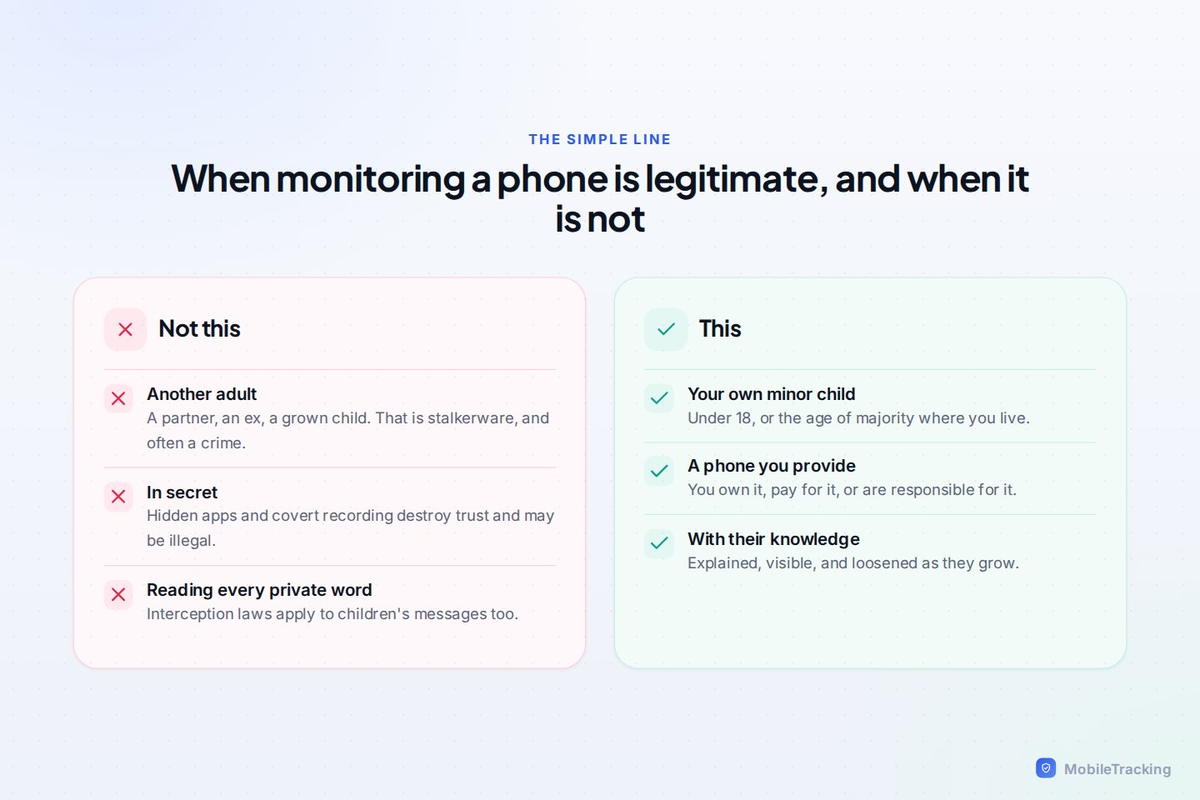
- The person being monitored is a minor, under 18, or the relevant age of majority where you live.
- You are that child’s parent or legal guardian.
- The device is one you own or provide, or are otherwise responsible for.
Get all three right and you’re on solid ground. Every complication in this article comes from one of them being fuzzy, the child is nearly an adult, the “parent” is a step-parent without formal guardianship, or two separated parents disagree.
Where it gets genuinely complicated
Older teens and the approach to 18
The law and the ethics move in the same direction here: the closer your child gets to adulthood, the more the balance tips toward their privacy and away from your oversight. A degree of monitoring that’s completely reasonable for an eleven-year-old looks very different applied to a seventeen-year-old. And there’s a hard edge at the end of it, the day your child turns 18, they are legally an adult. Monitoring their phone without consent stops being a parental right at that point, even if they still live at home and you still pay the bill. The sensible plan is to wind monitoring down as they approach that line, not to run it at full strength and switch it off overnight.
Seeing activity vs reading content
There’s a legal distinction, in many places, between seeing that a communication happened and reading what it said. Laws around the interception of the content of communications are often stricter than those covering metadata, the who, when and how often. This is one practical reason a safety-signals approach, which flags unknown contacts and keyword hits rather than logging every private message word for word, tends to sit on firmer legal ground. It’s also, not coincidentally, the more defensible approach as a parent.
Stepchildren and guardianship
If you’re not the legal parent or guardian, a step-parent without formal guardianship, say, or a relative helping to raise a child, your authority to monitor may be weaker or unclear. It’s worth understanding where you actually stand legally rather than assuming a parental role automatically carries parental rights over a device.
Separated and divorced parents
This is the big one, and it causes more trouble than any other scenario. Monitoring a child across two households, where the parents don’t agree, is a reliable way to turn a phone setting into a custody dispute. One parent quietly installing monitoring the other doesn’t know about can be treated as a serious breach in a family-court context. The safe path is to agree together, ideally in writing, on what’s monitored and why, and if you genuinely can’t agree, that’s a conversation for a lawyer or mediator, not something to do unilaterally and hope it doesn’t come up.
The bright red line: another adult is off-limits
Everything above concerns a minor child in your care. Monitoring another adult, a spouse, a partner, an ex, an employee, without their knowledge and consent is a completely different legal animal, and in many places it is simply a crime. This is the line that separates parental control from what’s often called “stalkerware,” and it isn’t a fine or a grey area you can talk your way around.
This is also a useful way to judge a product, not just a use. Reputable parental-control tools are built for parents and their own children, and they say so plainly in their marketing and their terms. If a product’s pitch is about secretly catching a cheating partner, or spying on staff, treat that as a red flag about the product itself, and never use any tool that way, whatever the marketing implies. Paying a phone bill, sharing a home, or being in a relationship does not create a right to monitor another adult in secret.
Consent isn’t just a legal nicety, it’s the smart move
Here’s something that surprises a lot of parents: even where the law would let you monitor a younger child without telling them, doing it openly is almost always the better choice, on both legal and practical grounds.
Legally, telling your child removes ambiguity. A monitored child who knew and didn’t object is a very different situation, in most frameworks, from one who was watched in secret. Practically, consent is what makes monitoring actually work: a child who knows the app is there and can see what it does treats the rules as fair, while a child who discovers hidden surveillance learns to hide better and to trust you less. The secret version is worse at the very job it’s supposed to do.
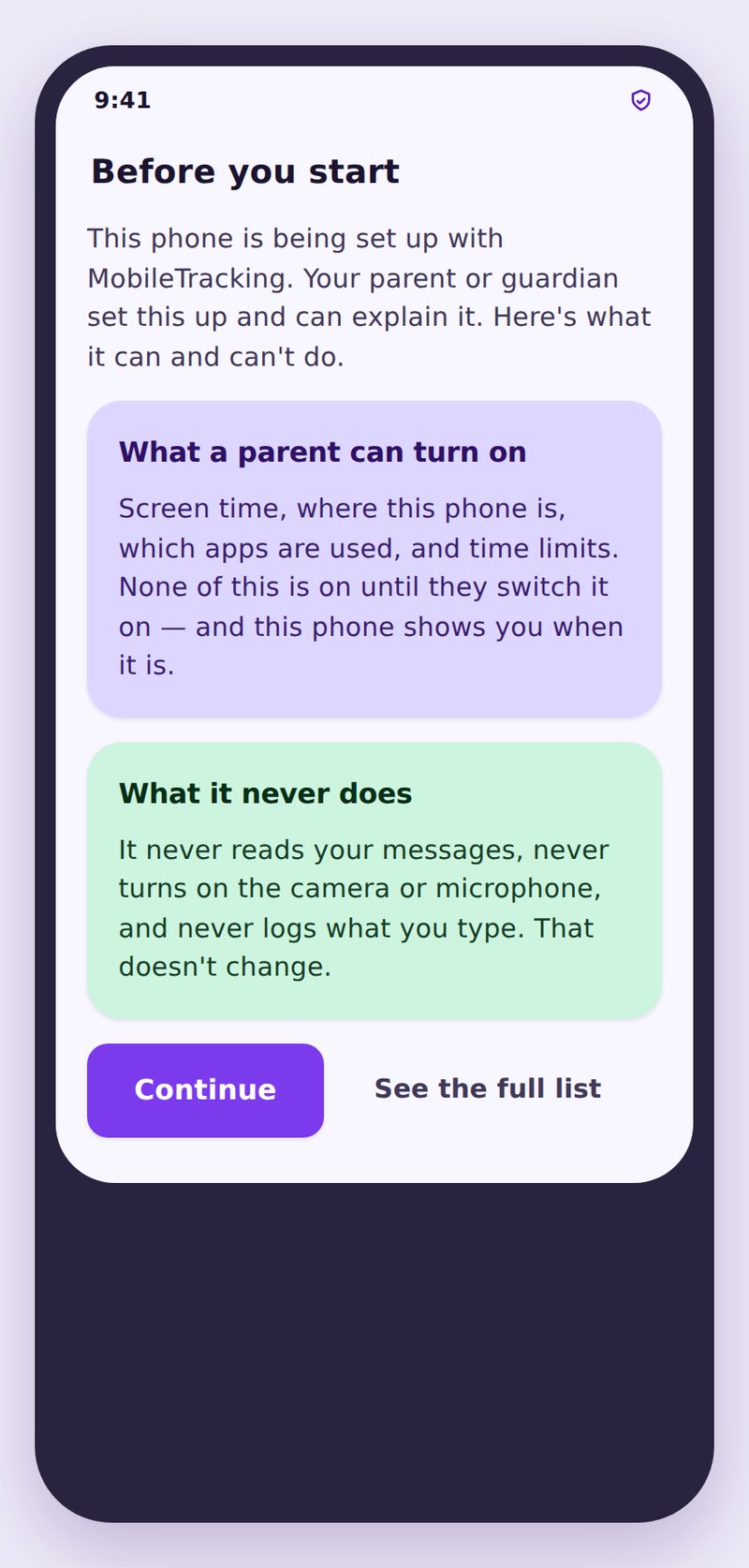
So the strongest position, legally and as a parent, is monitoring that’s proportionate to your child’s age, focused on safety rather than curiosity, and visible to the person it’s on. That combination is hard to fault from any direction.
It’s not just “can I monitor your child’s phone”, it’s “what happens to the data”
There’s a second legal layer that parents often miss entirely, and it’s about the information the app collects rather than the act of collecting it. Data-protection laws, the GDPR across Europe, COPPA in the United States, and equivalents elsewhere, govern how children’s personal data is gathered, stored and used. For a family, the practical upshot is that the tool you choose is now holding sensitive information about a child, and it should treat that data accordingly: store it securely, never sell it, and let you delete it whenever you want.
This is a genuine reason to read a parental-control app’s privacy policy before you commit, boring as that sounds. An app that hoovers up your child’s data and is vague about where it goes is a problem regardless of whether your monitoring is legal, because you’ve handed a third party a detailed record of a child’s life. Choose one that’s clear and restrained about what it keeps.
A simple test you can apply
If you’re unsure whether your decision to monitor your child’s phone sits on the right side of the line, run it through three questions:
- Is this my own minor child, on a phone I own or provide? If the answer is no, stop, you may not have the right to do this at all.
- Does my child know? If no, there had better be a serious, specific safety reason, and even then the plan should be to move toward openness rather than away from it.
- Is it proportionate to their age and the actual risk? Reading a sixteen-year-old’s every message “just in case” fails this test even if it’s technically legal.
Three clear yeses and you’re almost certainly fine, both legally and ethically. A no anywhere is a signal to rethink before you go further.
What about school-issued devices?
A lot of children now carry a device the school owns, a Chromebook or a tablet, and the rules there are different again, because you’re not the owner. Schools generally have the legal right to monitor and filter the devices they issue, and many do, sometimes more heavily than parents realise. What they can monitor is usually limited to school purposes and school time, but the boundaries vary by country and by district.
Two practical points follow. First, you often can’t install your own monitoring on a school-managed device, and trying to fight the school’s software can break the device or the account. Second, it’s entirely reasonable to ask your school what they collect, how long they keep it, and who can see it. Student-data privacy is a live issue, and a school that handles it well will have clear answers. If your child uses a school device at home, the sensible approach is to layer your household’s own rules, such as where and when it’s used, on top of whatever the school runs, rather than trying to override the school’s system.
Where MobileTracking fits
MobileTracking is built specifically for the lawful case: a parent or guardian looking after their own minor child, on a phone they’re responsible for, with the child’s knowledge. It’s visible on the child’s phone, it focuses on safety signals rather than reading private messages, and it lets you export or delete your family’s data at any time. Its terms are explicit that it is not for monitoring other adults, because that’s the line that actually matters, and a tool that respects it is one you can use with a clear conscience.
Frequently asked questions
Do I legally have to tell my child I’m monitoring their phone?
For a younger child, the law often doesn’t strictly require it, but telling them is strongly advised, for trust, and because it removes any legal grey area. For older teens, transparency matters more, both legally and practically.
Can I keep monitoring my child’s phone after they turn 18?
Not without their consent. At 18 they’re an adult, and monitoring an adult without agreement is no longer a parental right, whoever pays for the phone.
Is it legal to monitor my partner’s or spouse’s phone?
Monitoring another adult without their consent is illegal in many places, and it is not what parental-control tools are for. Don’t do it, whatever a product’s marketing implies.
What about a phone I pay for that my adult child uses?
Paying the bill doesn’t grant a right to monitor an adult’s phone without consent. Age, not who holds the contract, is what governs this.
Do both parents need to agree?
Where parents share custody, it’s wise, and sometimes legally required, for both to agree before monitoring a child, particularly after separation. Doing it unilaterally can backfire badly in a custody context.
Note: this article is general information, not legal advice. Monitoring laws vary by country and state, and situations involving custody or separation can be legally delicate. For a specific case, consult a qualified legal professional where you live.
Can my child legally consent to being monitored?
A younger child can’t give full legal consent, which is part of why a parent’s authority matters. But telling them and getting their agreement still counts for a lot, both ethically and in removing any grey area. As they get older, their consent becomes more meaningful, and by 18 it’s required.
Is it legal to read my child’s actual text messages and social media?
For a younger child on a device you provide, the law in many places allows a parent broad oversight, but reading the private content of messages sits on more sensitive ground than seeing who they talk to, and stricter interception rules can apply to the content of communications in some jurisdictions. Beyond the strict legality, reading everything tends to be counterproductive and erodes trust. The stronger position, legally and practically, is proportionate, transparent oversight focused on safety signals rather than reading every private message, becoming more hands-off as your child gets older.
Keep going
Read our guides on transparent monitoring for families, how to tell your child you’re installing a parental control app, and setting up parental controls on Android. For trusted guidance beyond this site, Common Sense Media is a well-regarded resource for parents: Common Sense Media.