Search “monitor my child’s phone” and half the results promise you something unsettling: watch everything, secretly, without them ever knowing. It’s pitched as a feature. It’s actually the single biggest mistake a parent can make in this whole area, and there’s a better way that keeps the safety and drops the poison.
The better way is transparent monitoring. Your child knows the app is there. They can see exactly what it shares. And the rules are something you worked out together, rather than something you’re doing to them behind their back. It sounds softer than the secret approach. It’s actually far stronger, because it keeps the one thing that genuinely keeps kids safe over the long run: their trust in you.
We build MobileTracking around this idea, so we’re not a neutral party. But we didn’t invent the argument, and you don’t have to take our word for it, child psychologists and online-safety organisations make the same case, for the same reasons. Here’s the reasoning, and a practical model any family can actually follow.
Why secret monitoring backfires
Covert monitoring fails in three fairly predictable ways, and it’s worth walking through each, because the failures aren’t obvious until you’ve seen them play out.
They find out. This is almost a certainty, not a risk. Kids are frequently more fluent with their own devices than their parents are, and hidden apps get discovered, a stray notification, a friend who knows the signs, a phone acting oddly. When a child discovers they’ve been watched in secret, the damage isn’t really about whatever you saw. It’s the betrayal. A kid who learns their parent has been secretly reading their life will often pull back hard, and that rupture can do more harm than the thing you were worried about in the first place.
It teaches the wrong lesson. Children learn what relationships are supposed to look like from the ones they’re in. A child raised to accept that the people who love them watch them in secret is being taught that surveillance is a normal feature of intimacy. That’s a lesson that follows them into their friendships and, later, their romantic relationships, and it’s not one most parents would choose to teach on purpose.
It doesn’t even work. Here’s the practical kicker: secret monitoring is bad at its own job. A teenager who suspects they’re being watched doesn’t stop doing the things you’re worried about, they move them somewhere you can’t see. A second phone, a friend’s device, an app you’ve never heard of, an account under a fake name. You end up with a dashboard full of the innocent stuff and blind to the rest, which is the exact opposite of what you wanted. You know less, not more.
What transparent monitoring looks like
Transparent monitoring keeps every safety benefit and simply removes the corrosive secrecy. In practice it comes down to four commitments:
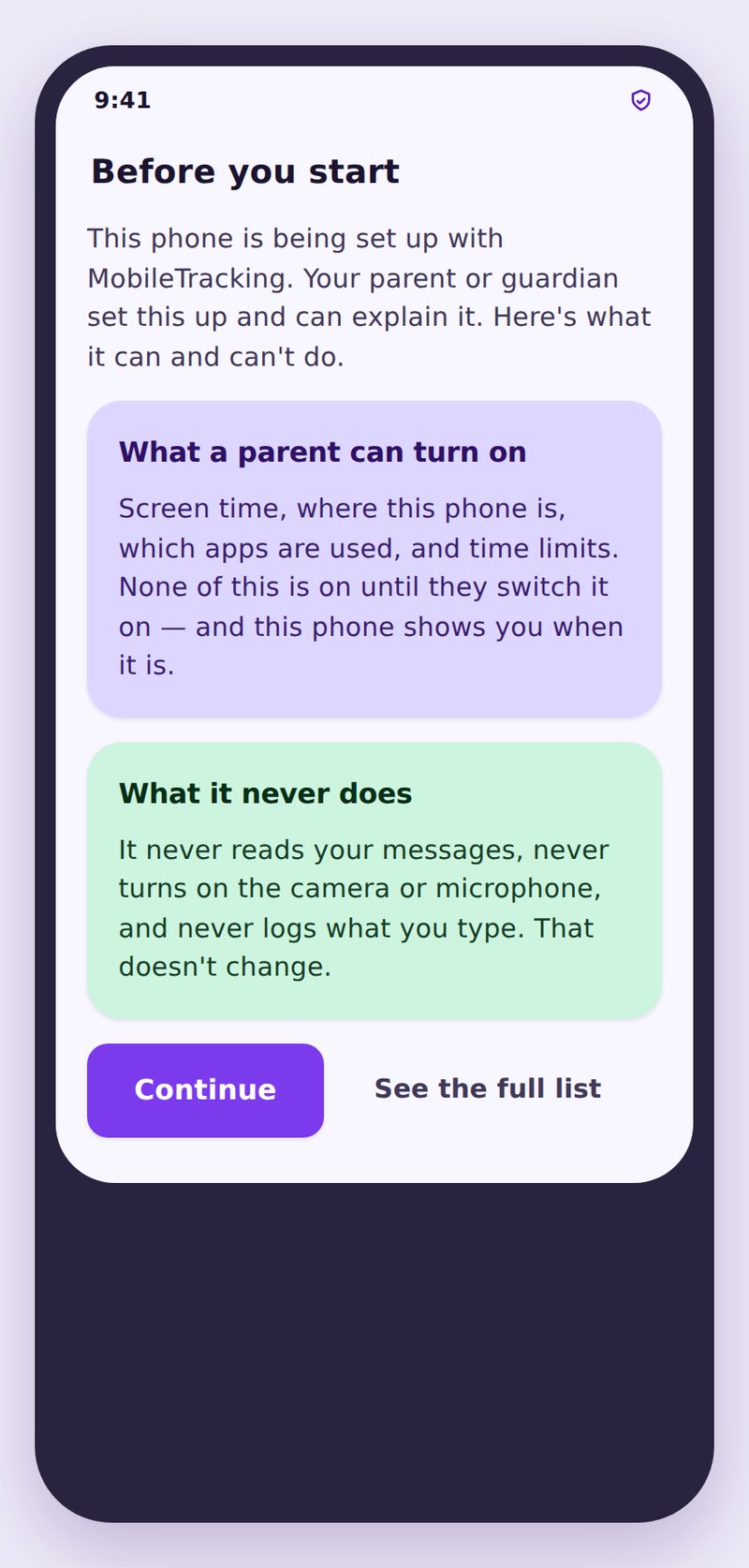
- The child knows the app is installed. It’s visible on their phone, not disguised or hidden.
- The child can see what’s shared. There’s a plain screen listing exactly what leaves the phone, and, just as importantly, what never does.
- The rules are discussed, not sprung. You set them together, and your child can ask about them and push back.
- Monitoring loosens as trust grows. It’s a starting point for a nine-year-old with a first phone, not a permanent condition for a seventeen-year-old.
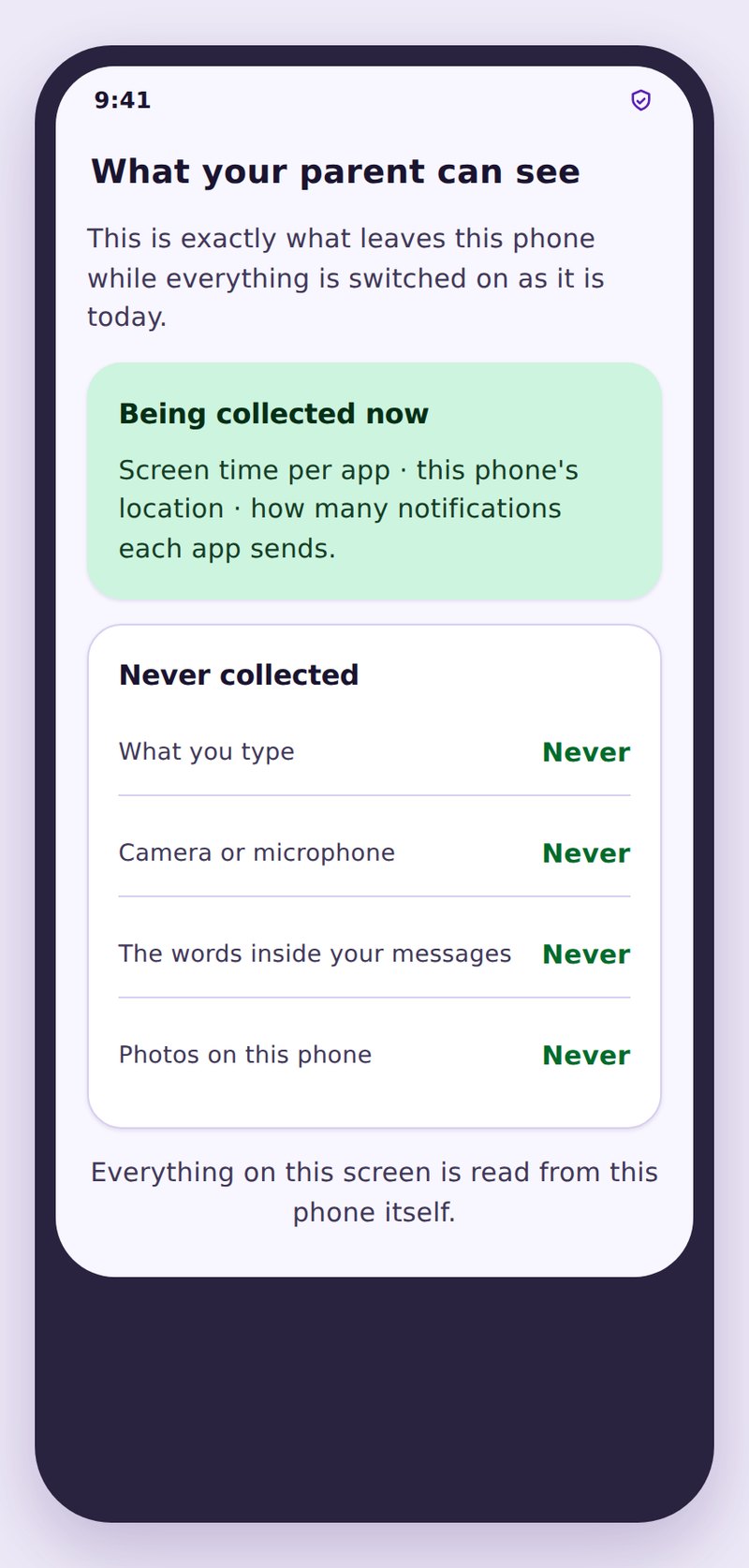
None of this makes monitoring toothless. You still see the safety signals that matter. You’ve just done it in a way that strengthens the relationship instead of quietly undermining it.
1. Have the conversation before you switch anything on
The whole model rests on one conversation, and it’s worth getting right.
Before you turn on a single feature, tell your child what you’re doing and, more importantly, why, in specific, safety-focused terms rather than vague distrust. Not “because I need to keep an eye on you,” which sounds like an accusation, but “I want to know you got to school okay, and I want a filter on so you don’t stumble into stuff that’s genuinely horrible.” Concrete reasons are much easier to accept than a general air of suspicion.
Then let them talk. Let them ask questions, raise objections, and, this is the part that pays off, have some say in the terms. A ten-minute conversation up front does two things at once: it prevents the discovery-and-betrayal cycle entirely, because there’s nothing to discover, and it turns the whole arrangement into something your child had a hand in rather than something imposed on them.
2. Draw a clear line at message content
This is where a lot of the ethical weight sits, so it deserves its own decision.
There’s a meaningful difference between knowing your child got repeated calls from a number nobody recognises, and sitting down to read every message they’ve ever sent their best friend. The first is a safety signal. The second is a violation of the ordinary privacy a growing person needs in order to become themselves.
Transparent monitoring deliberately focuses on the signals, who they talk to, unknown contacts, time spent on apps, keyword alerts for genuine danger, and leaves the everyday content of a teenager’s private life alone. That line is what separates a safety tool from surveillance, and it’s the difference between a child who feels protected and one who feels watched. Decide where your line is, tell your child exactly where it is, and then actually hold it, even when you’re curious. Especially when you’re curious.
3. Make it visible on their device
The most important single design choice in the whole model is that the app lives on the child’s phone and openly shows what it does. When a new thing gets switched on, their phone can tell them.
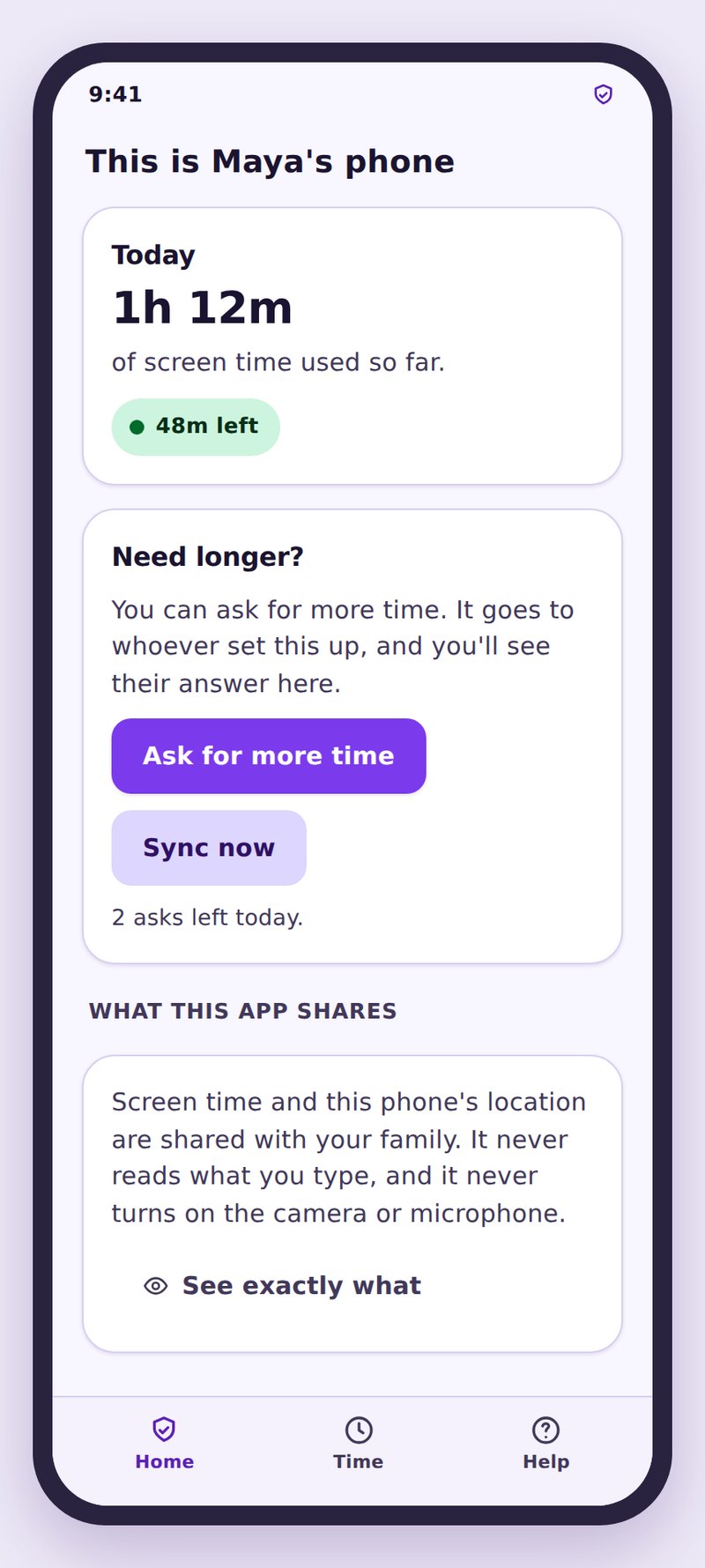
This kills the “gotcha” dynamic stone dead. There’s no moment where you reveal something you secretly knew, because there’s nothing you secretly knew, everything you can see is something they knew you could see. It also hands the child a bit of agency. They can look at the same information you can, and that symmetry is a huge part of what makes the whole thing feel fair rather than one-sided.
4. Loosen it as they grow
Monitoring should be a dimmer switch, not an on/off one, and the plan should always be to turn it down over time.
What’s completely reasonable for a nine-year-old with their first phone becomes overbearing and counterproductive for a sixteen-year-old who’s consistently shown good judgement. So plan the step-down in advance, and tell your child about it, because it’s genuinely motivating. As they demonstrate they can be trusted, start switching things off, drop the location history first, then relax the web filter, then stop the app-time reports. Saying “we’re loosening this because you’ve earned it” is one of the most powerful sentences a parent has, and it reframes the earlier, tighter phase as a stage they’re growing out of rather than a cage they’re stuck in.
Aim to arrive at eighteen with the monitoring essentially gone, because at that point they’re an adult and it should be. The goal was never permanent oversight. It was to keep them safe while they learned to keep themselves safe.
5. The test: would you show them your dashboard?
Here’s a simple gut-check for whether your monitoring has stayed on the right side of the line. Ask yourself: would you be comfortable showing your child the exact screen you look at?
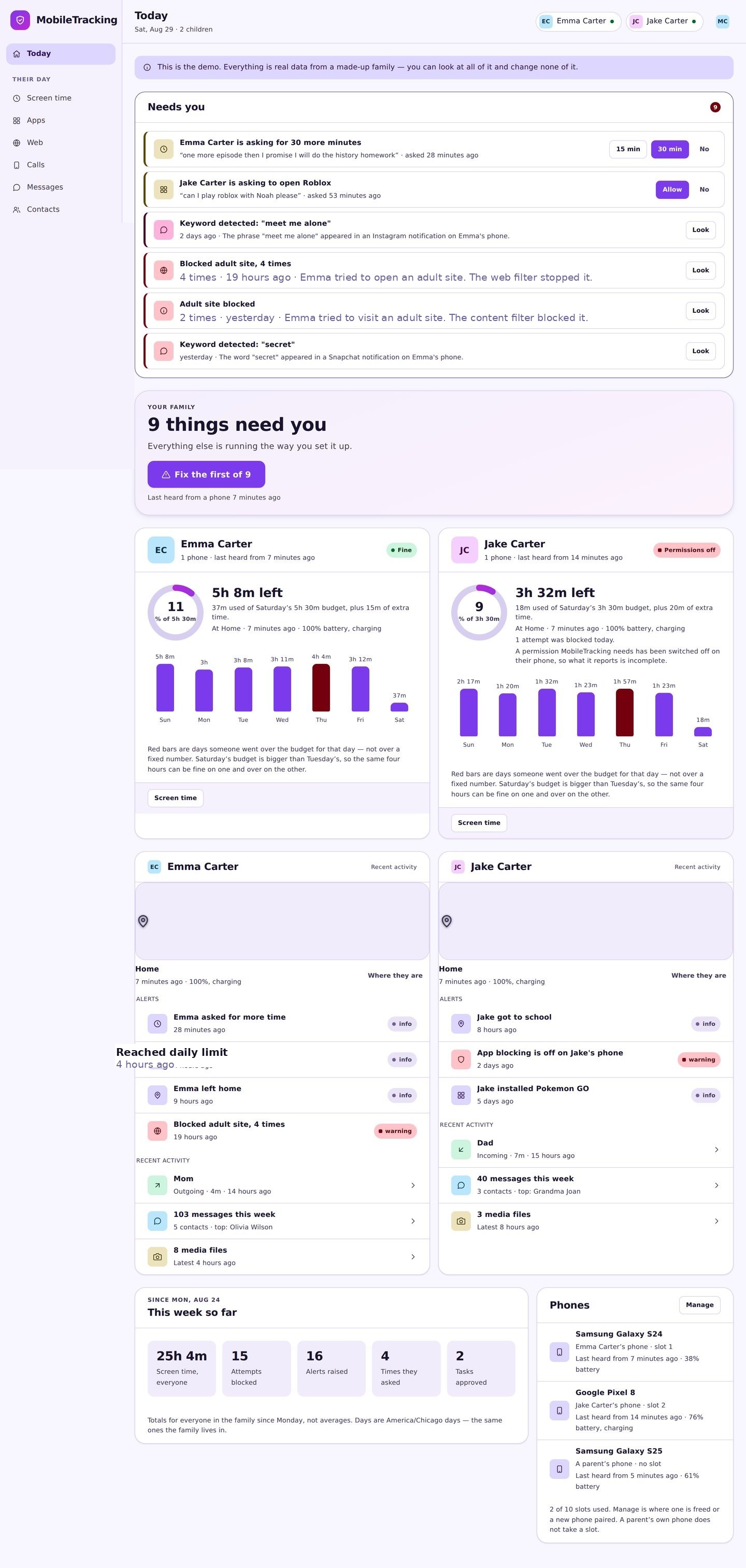
If the answer is yes, if there’s nothing on your dashboard you’d be embarrassed for them to see you seeing, then you’re doing this well. If the honest answer is no, if there’s stuff in there you’d rather they didn’t know you could see, that’s your signal. You’ve drifted from safety into surveillance, and it’s time to pull back. It’s a small question, and it catches the drift before it becomes damage.
Handling the objection “you don’t trust me”
At some point, a teenager is going to say it: “if you have to monitor me, you obviously don’t trust me.” It’s worth having an answer ready, because it’s a fair challenge and it deserves a real response rather than defensiveness.
The honest reply is that this isn’t about trusting them, it’s about the fact that the online world is genuinely dangerous in places, and that even trustworthy people get targeted by scams, strangers and pressure they didn’t invite. You can frame it as a safety net, the same way a seatbelt isn’t an accusation that they’re a bad passenger. And you can point to the step-down: the monitoring loosens as they get older precisely because you trust them more over time. That turns the tool from evidence of distrust into a visible mechanism for earning independence, which is a much better story for both of you.
What transparent monitoring can’t do
Being open about monitoring means accepting a real trade-off, and it’s only fair to name it. A child who knows what’s watched can, in principle, route around it. That’s true, and it’s the genuine cost of doing this ethically rather than covertly.
But the trade is worth making, because the alternative buys you a little short-term visibility at the price of the long-term trust that actually keeps kids safe as they get older and the stakes get higher. And transparent monitoring, like any tool, isn’t a parenting strategy by itself. It’s a safety layer that works alongside an open door and ongoing conversation, not a substitute for them. The families who do best pair a visible, reasonable tool with a relationship where their kid still tells them things. The tool supports the relationship. It can’t replace it.
Where a tool like MobileTracking helps
MobileTracking is designed for this model from the ground up. On the child’s phone it runs as a visible “MobileTracking Family” app with a transparency screen that spells out exactly what’s shared, and it never logs keystrokes or turns on the camera or microphone, full stop. It focuses on safety signals rather than reading private messages, and every protection can be loosened as your child earns it. It’s monitoring you can be comfortable telling your kid about, because it was built to be told about.
Frequently asked questions
Should I ever monitor my teen secretly?
As a general rule, no. Secret monitoring damages trust badly when it’s discovered, and it pushes kids to hide. A genuine, specific safety emergency is its own situation, but for everyday parenting, open beats covert every time.
Isn’t any monitoring a violation of my child’s privacy?
A parent has both the right and the responsibility to keep a minor safe, which reasonably includes some oversight of a phone you provide. The key is proportion and honesty, safety signals, openly, loosening with age, rather than reading everything.
What if my child flatly refuses to be monitored?
Listen first, explain your specific safety reasons, and negotiate the terms together. Very often the real objection is to feeling spied on, which transparent monitoring directly answers. Agreeing the rules jointly usually resolves it.
Should my child be able to see what I can see?
Ideally, yes. That symmetry is the single clearest signal that your monitoring is about safety rather than control, and it’s what keeps the whole arrangement feeling fair.
Isn’t transparent monitoring easier for a child to get around?
In theory a child who knows monitoring is there could try to avoid it, but in practice covert monitoring is no more durable, children discover that too, often sooner than parents expect, and when they do it fails far more destructively. The point of transparent monitoring is not to be an inescapable trap; it is to be one honest layer of safety within a trusting relationship. A child who knows the monitoring exists and feels able to talk to you is safer than one watched in secret, because the relationship, not the surveillance, is what protects them most.
How should transparent monitoring change as my child grows?
It should steadily shrink and shift from oversight toward coaching. What is reasonable for a ten-year-old becomes intrusive for a sixteen-year-old, so the scope narrows, more day-to-day judgement passes to the teen, and the conversations matter more than the tools. Winding monitoring down as your child demonstrates responsibility is not a loss of control but the whole goal: a young person ready to manage their own online life by the time they are doing it without you.
Keep going
Read our guides on whether it’s legal to monitor your child’s phone, setting up parental controls on Android, and cutting screen time without a fight. For trusted guidance beyond this site, Common Sense Media is a well-regarded resource for parents: Common Sense Media.