The quickest way to know whether you can record a phone call is to answer two questions: does the law where you are need one person’s consent or everyone’s, and where is the other person? In the US, federal law and most states let you record a call you are taking part in. About a dozen states, including California, Florida, Illinois, Pennsylvania and Washington, need everyone on the call to agree. The UK and Canada generally let a participant record for their own use, while Germany, France and several Australian states are much stricter.
If the two of you are in different places, assume the stricter rule applies. The simplest safe habit works almost everywhere: say you are recording at the start, on the recording, and carry on only if the other person is happy. This guide is general information, not legal advice. Check the current law where you live, and speak to a lawyer if the recording could end up in a dispute or in court.
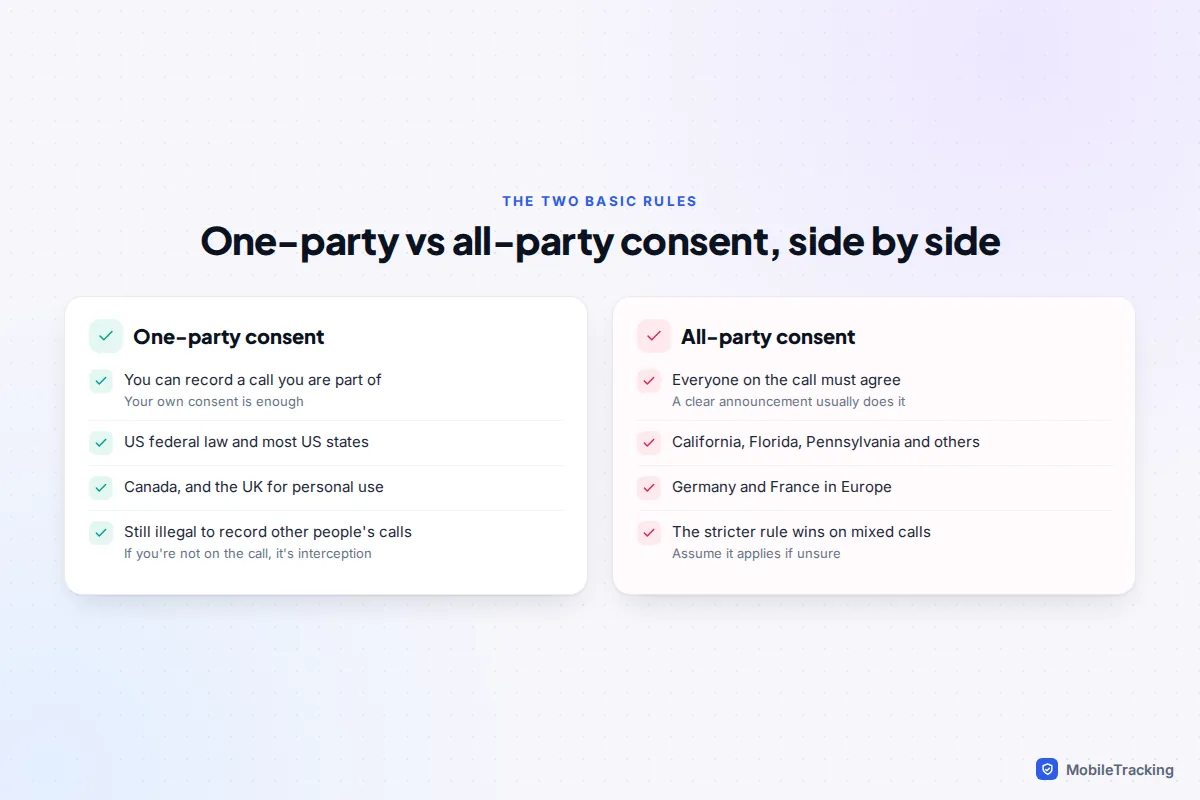
One-party and all-party consent, in plain terms
One-party consent means a call can be recorded if at least one person on it agrees. If you are on the call, that person can be you, so you may record without asking. All-party consent (sometimes called two-party consent) means everyone on the call must agree before anyone records it. On a three-way call, that is all three people.
Neither rule lets you record a conversation you are not part of. Setting up a phone, app or recorder to capture calls between other people, such as a partner, housemate or employee, is interception. In the US it can be a federal crime under the Wiretap Act, and similar offences exist in the UK, Canada, Australia and across Europe. This guide is only about recording calls you are actually on.
Consent doesn’t have to be a signature. In many all-party places, a clear announcement followed by the other person choosing to continue counts. A spoken or written “yes” is stronger still.
The US rule: federal law and the all-party states
US federal law sets the floor. Under 18 U.S.C. § 2511(2)(d), it is lawful to record a phone, in-person or electronic conversation if you are a party to it, or if one party has consented, unless the purpose is to commit a crime or a tort. That is one-party consent, and it applies to calls between states.
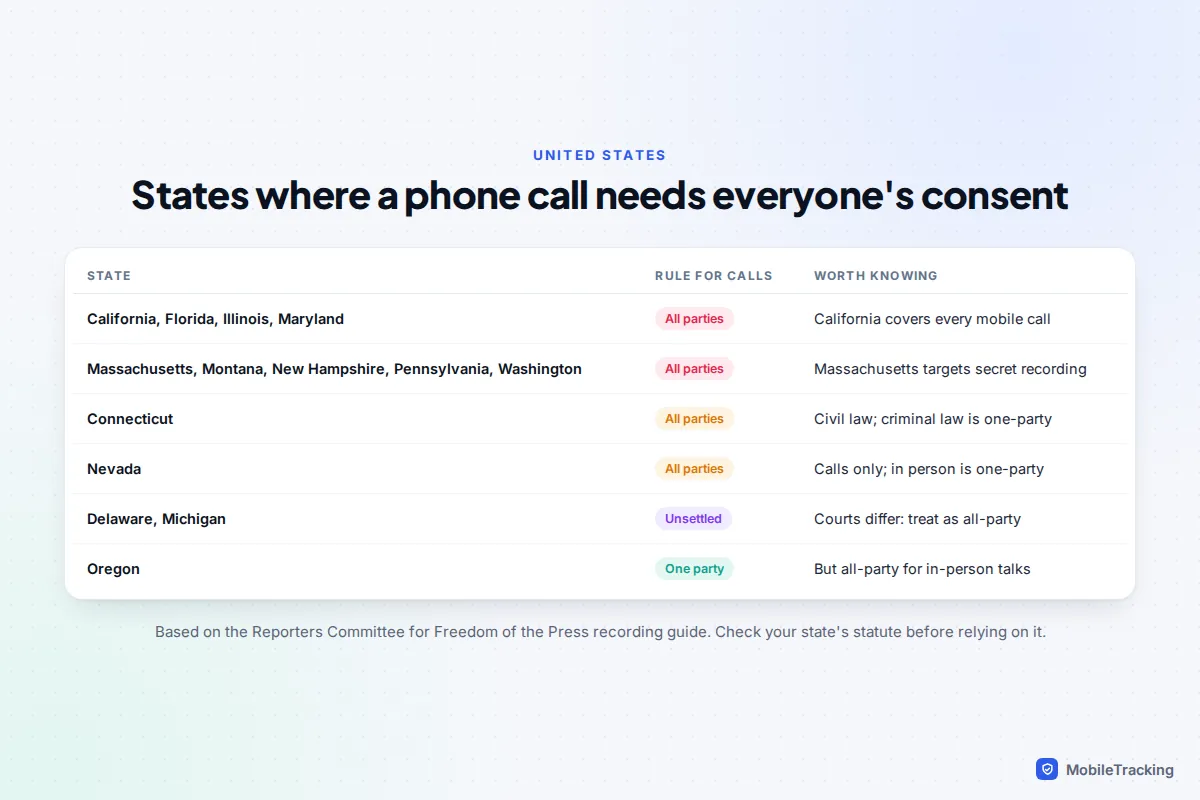
States can be stricter, and several are. According to the Reporters Committee for Freedom of the Press, which keeps a state-by-state recording guide for journalists, 11 states primarily require all-party consent: California, Delaware, Florida, Illinois, Maryland, Massachusetts, Michigan, Montana, New Hampshire, Pennsylvania and Washington. Connecticut and Nevada require everyone’s consent for phone calls, but not for in-person conversations.
The details that trip people up
- California has two rules. Penal Code § 632 covers confidential conversations, and § 632.7 requires everyone’s consent to record any call involving a mobile or cordless phone, whether or not it is confidential. Someone recorded unlawfully can sue for $5,000 or three times their actual damages, whichever is greater.
- Connecticut’s criminal law is one-party, but a civil law lets people sue unless all parties agreed in writing, agreed on the recording, or heard a recorded warning.
- Michigan’s appeals courts have said since 1982 that a participant can record their own conversation, but the state’s Supreme Court has never ruled on it. Delaware has two statutes that point in different directions. Treat both as all-party.
- Massachusetts targets secret recording. If the other person clearly knows you are recording, you are generally on firmer ground.
- Oregon is one-party for phone calls but all-party for in-person conversations, so recording someone across a table is different from recording them on the phone.
- Washington’s statute spells out that consent is obtained if you announce, in a reasonably effective way, that the call is about to be recorded, and that announcement is itself recorded.
Calls across state lines or borders
This is where most confusion comes from. You might be in Texas, which is one-party, and call someone in California, which is all-party. There is no single federal rule that settles which state’s law wins, and courts look at the facts of each case.
The best-known example is a 2006 California Supreme Court case, Kearney v. Salomon Smith Barney. A brokerage based in Georgia, a one-party state, recorded calls with clients in California. The court held that California’s all-party law applied to those calls. The practical lesson is simple: if either of you is in an all-party state, act as though that law applies to you.
A mobile number tells you nothing about where someone is standing: a friend with a New York number might be on holiday in Florida. International calls work the same way. If you don’t know where the other person is, treat the call as all-party.
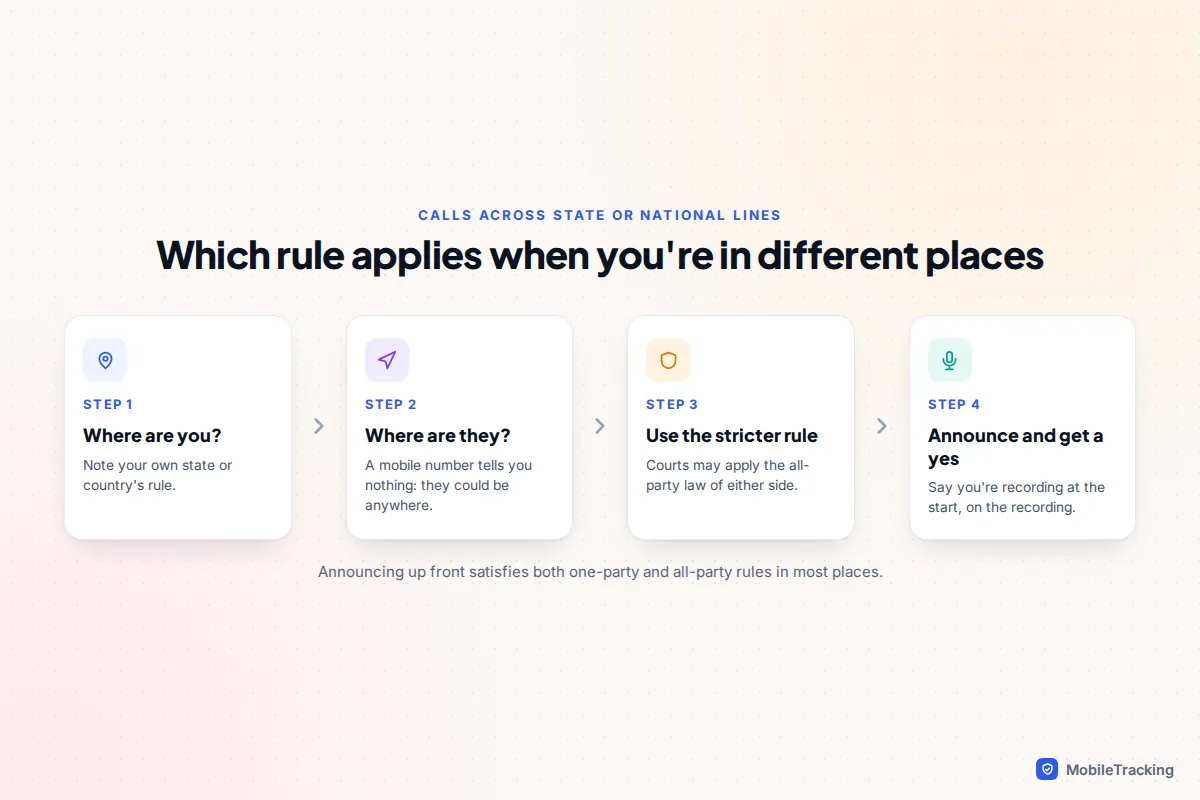
In practice: Maria in Ohio phones her insurer’s claims line in Illinois. She wants her own copy, so she says, “I’m recording this call too, for my records. Is that all right?” The agent agrees, on tape. Whatever state’s law a court later applies, everyone knew and agreed.
Outside the US: UK, EU, Canada and Australia
These are general positions only, and the rules for sharing a recording are often stricter than those for making one.
United Kingdom
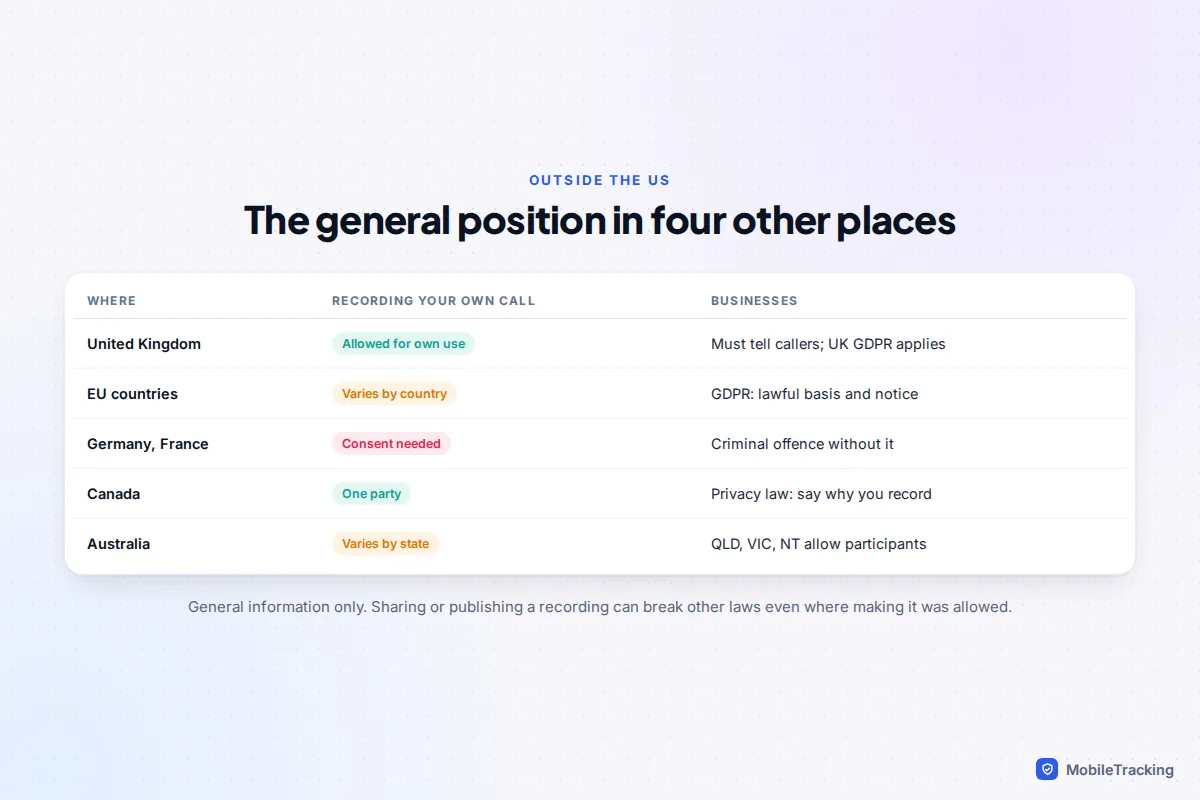
UK interception law is aimed at people listening in on calls they are not part of. It has long been understood that a participant may record their own call for their own use, such as keeping an accurate note, without telling the other person. What you do next matters. Passing the recording to others or posting it online can raise data protection, confidentiality or harassment issues. Businesses are different: they need a lawful purpose under the Investigatory Powers (Interception by Businesses etc. for Monitoring and Record-keeping Purposes) Regulations 2018, and UK GDPR means they must tell callers and explain why.
European Union
GDPR doesn’t apply to purely personal or household activity, so recording a call for your own notes usually falls outside it. National criminal law is another matter. Germany makes it an offence under § 201 of its Criminal Code to record someone’s privately spoken words without consent, and France’s Penal Code has a similar offence in Article 226-1. Businesses everywhere in the EU need a lawful basis under GDPR and must inform callers.
Canada
Section 184 of the Criminal Code makes it an offence to intercept a private communication, but not where one of the people communicating consents. A participant can therefore record their own call. Organisations that record customer calls must follow privacy law, usually PIPEDA, which is why you hear “this call may be recorded for quality purposes”: they must say why, and use the recording only for that purpose.
Australia
Each state and territory has its own surveillance devices law. Queensland, Victoria and the Northern Territory generally allow a participant to record a private conversation. New South Wales, the ACT, Tasmania, South Australia and Western Australia generally require everyone’s consent, with narrow exceptions such as protecting your lawful interests. If callers are in different states, apply the stricter rule.
Built-in phone recorders announce themselves
Apple, Google and Samsung all designed their recorders to warn everyone on the call, which lets the feature work across one-party and all-party places.
- iPhone: since iOS 18.1 you can record a call from the Phone app. Apple says both participants hear an audio notice that the call is being recorded, and the notice replays during the call. Recordings and transcripts are saved in the Notes app. The feature is only available in selected regions and languages.
- Phone by Google (Pixel and some other Android phones): both people hear a disclosure when recording starts, and again when it stops. It needs a Pixel 6 or later on Android 14 or later, or Android 9 or later on other phones, and it isn’t offered in every country. Recordings stay on the phone.
- Samsung Galaxy: in the US, call recording arrived with One UI 7. Samsung says participants get an audio notification that the call is being recorded.
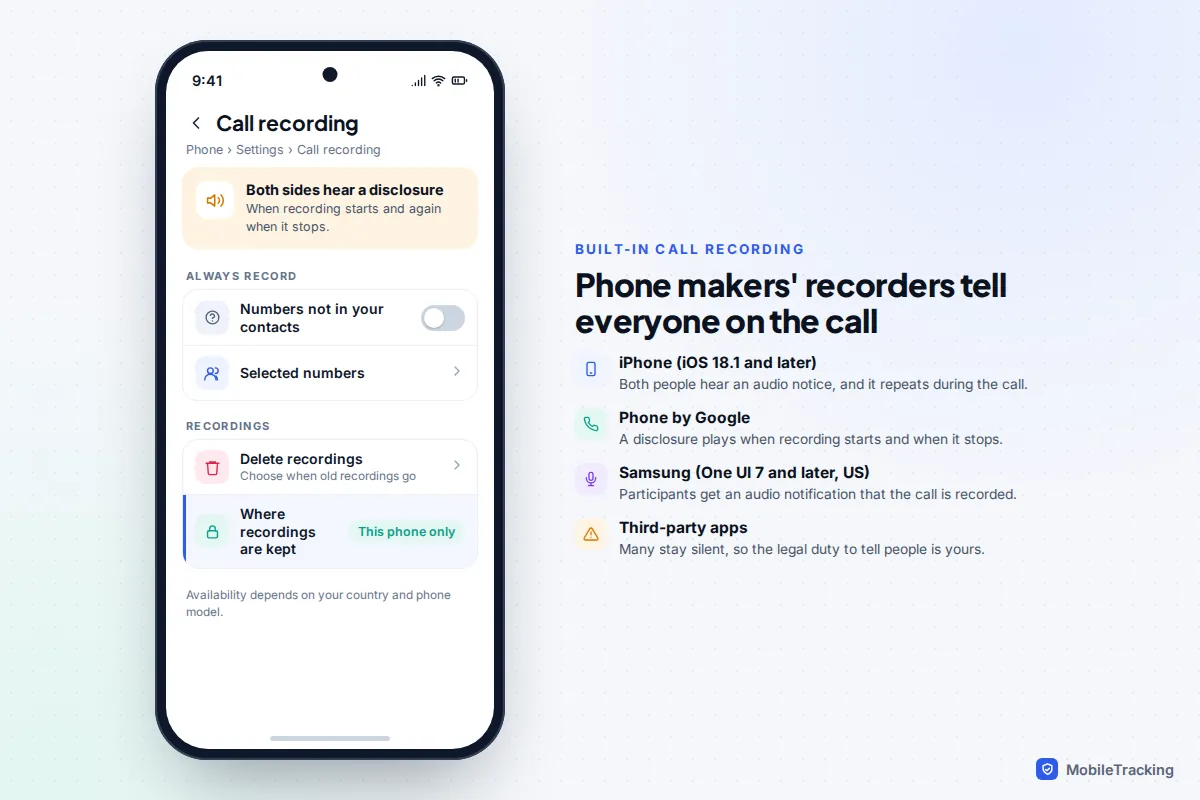
Third-party apps often record without any tone, but the duty to tell people is still yours. Our walkthrough on recording a call on iPhone the legal way covers the steps, and Apple’s personal safety guide to call recording explains what the other person hears. The same consent rules apply to video calls, which our guide to screen recording a video call covers.
Workplace and business calls
When a company says “this call may be recorded for training and quality purposes”, it is doing exactly what the law expects: telling you at the start. In most places, staying on the line after that message counts as agreeing to their recording. It doesn’t automatically cover yours. If you want your own copy of a call with your bank or energy supplier, say so at the start. Most agents will simply note it.
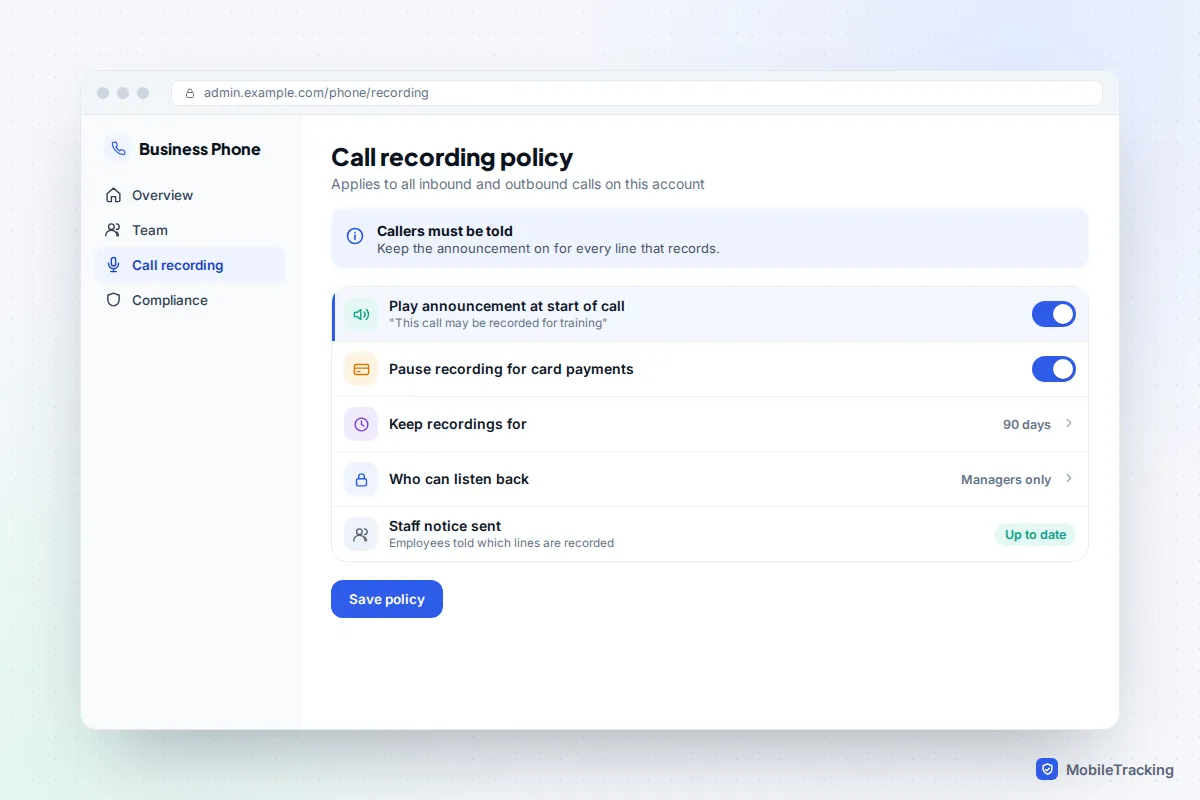
If you run a business line, the basics are similar in most countries:
- Play an announcement before recording starts, on every recorded line, including outbound calls.
- Tell your staff which lines are recorded and why, in writing.
- Decide how long you keep recordings and who can listen back, then stick to it.
- Pause recording while taking card details, since payment card security rules discourage storing them.
- Check any sector rules. Some regulated firms, such as those arranging investments in the UK, are required to record certain calls.
Employees recording their own work calls or meetings is a greyer area. It may be legal where you are and still breach your employer’s policy, which can lead to disciplinary action. If you are in a dispute at work, ask a union representative or employment adviser before you record anything.
How to record openly and fairly
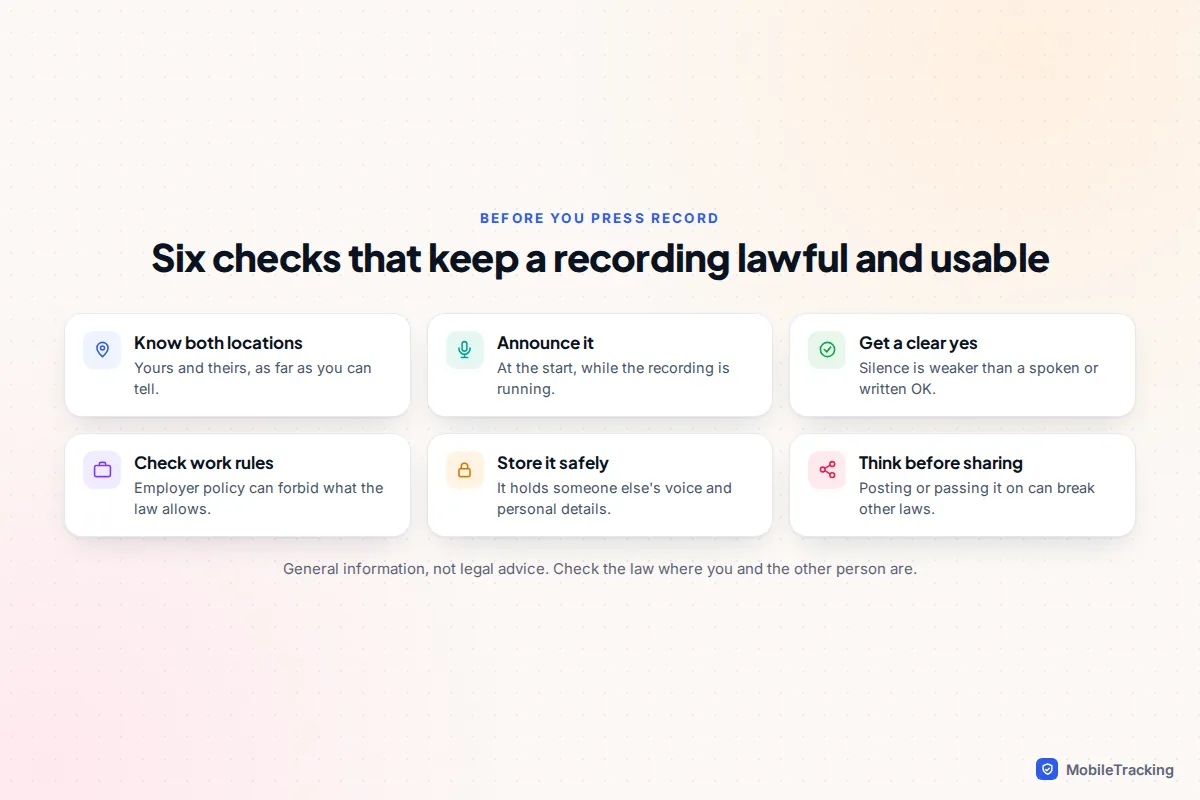
The legal minimum varies, but the fair approach is the same everywhere, and a recording everyone clearly agreed to is far harder to challenge.
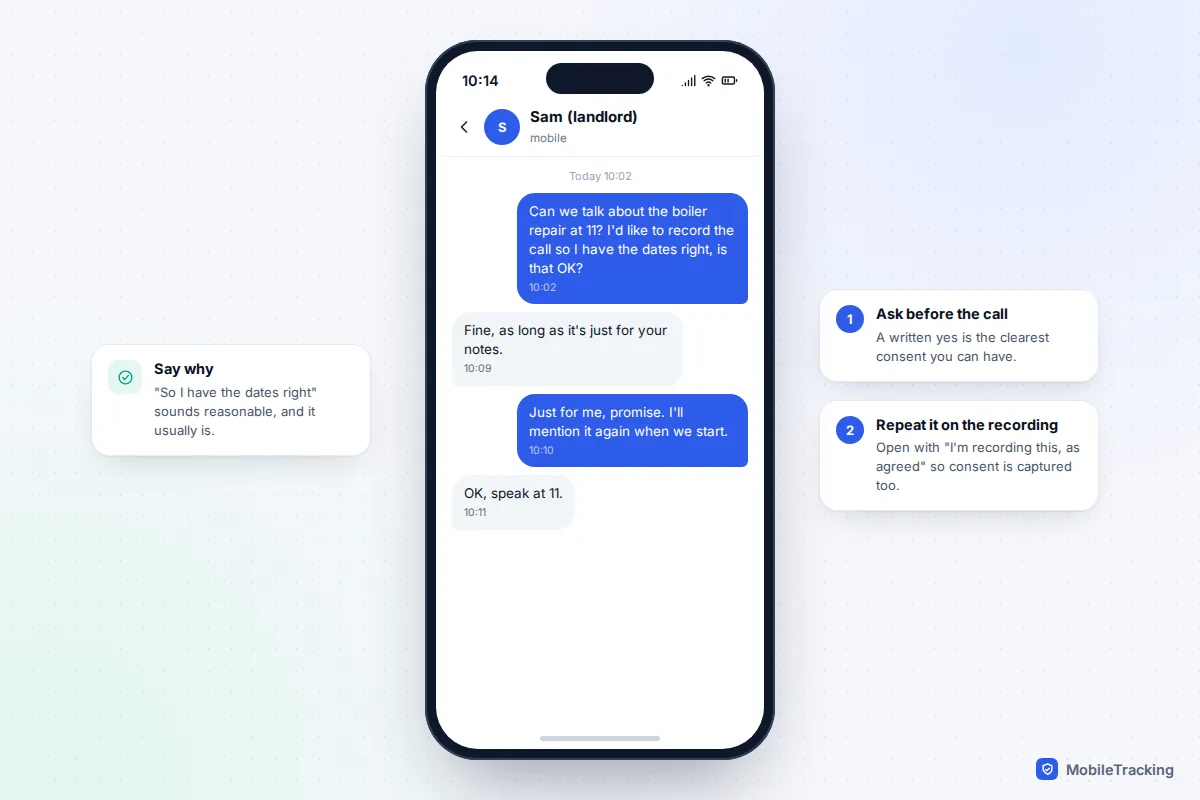
- Ask before the call if you can, ideally in writing. A text saying “Is it OK if I record so I get the details right?” is simple and clear.
- Start the recording, then say, “I’m recording this call, as we agreed,” so the consent is on the recording itself.
- If anyone objects, stop recording and take notes instead.
- Keep the file somewhere private, such as a passcode-protected phone or encrypted storage, and delete it when you no longer need it.
- Don’t share it beyond the purpose you gave without asking again.
Common mistakes
- Assuming your state’s rule is the only one. The other caller’s location can bring a stricter law into play.
- Relying on “they must have heard the beep”. A quiet tone they didn’t notice is weak evidence of consent.
- Recording other people’s calls “for their own good”. Parents sometimes ask about this. A few US courts have accepted a parent consenting on behalf of a young child in narrow circumstances, but it is unsettled law and doesn’t cover the other person on the call. Our guide on whether parents can legally monitor a child’s phone explains the wider picture, and talking openly is almost always the better route.
- Posting a recording to “prove a point”. Even a lawful recording can lead to a privacy or defamation claim once it’s public.
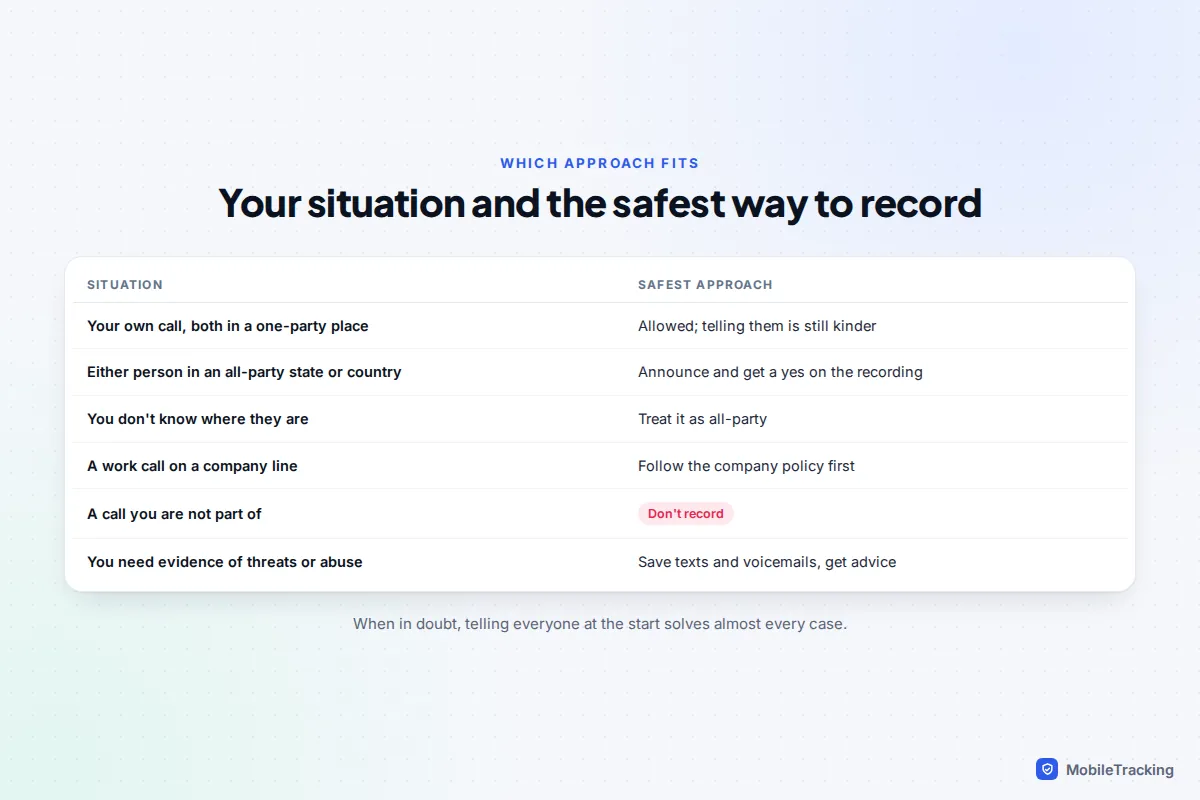
Which approach fits your situation
Use this as a starting point, then check the local law.
How to check the law where you live
- Find the statute itself on a government or legislature website, not a blog. Search your state or country plus “recording conversations law”.
- Read a reliable summary. In the US, the Reporters Committee recording guide covers every state. Elsewhere, your national privacy regulator, such as the UK’s Information Commissioner’s Office, is the best source.
- Check the date, because laws and court rulings change.
- Ask a professional if the recording could end up in court, a divorce, an employment dispute or a formal complaint.
Frequently asked questions
Is it legal to record a phone call without telling the other person?
In one-party places, such as most US states, Canada, and the UK for personal use, you can generally record a call you are on without telling the other person. In all-party states like California, Florida and Pennsylvania, and in countries such as Germany, you need everyone’s agreement. Telling people is the safe choice everywhere.
Which US states are two-party consent states?
The Reporters Committee lists California, Delaware, Florida, Illinois, Maryland, Massachusetts, Michigan, Montana, New Hampshire, Pennsylvania and Washington as primarily all-party, with Connecticut and Nevada requiring everyone’s consent for phone calls. Michigan and Delaware are unsettled, so treat them as all-party.
Does “this call may be recorded” mean I can record too?
Not automatically. The company’s message covers its own recording. If you want to record, say so at the start. Most customer service agents will accept it or tell you their policy.
Can I use a recording of a phone call as evidence?
Often, but it depends on the court, the country and how it was made. An unlawful recording may be excluded and can expose you to claims, so ask a lawyer before relying on one.
Can I turn off the announcement on my iPhone or Android recorder?
No. Apple, Google and Samsung built the notice in so the feature can be used lawfully, and there is no setting to remove it. Apps or tricks that claim to hide it don’t change your legal duty to tell people.