How to Read a Phone Bill’s Call Details

Open the itemised section of your bill, usually called “call details”, “itemisation” or “usage details”. Each line is one call, text or data session, and it shows five things: the date and time, the number, the destination or type (mobile, landline, international, premium), the duration and the charge. Anything covered by your allowance shows as £0.00, $0.00 or “Included”, so the lines worth your attention are the ones with a price next to them.
Three kinds of line cause most surprises: short-code texts and 09 or 118 calls, purchases billed through your network (“charge to mobile”), and roaming. This guide explains how to read every column, how UK and US bills differ, how to spot and block unwanted charges, and how to dispute one.
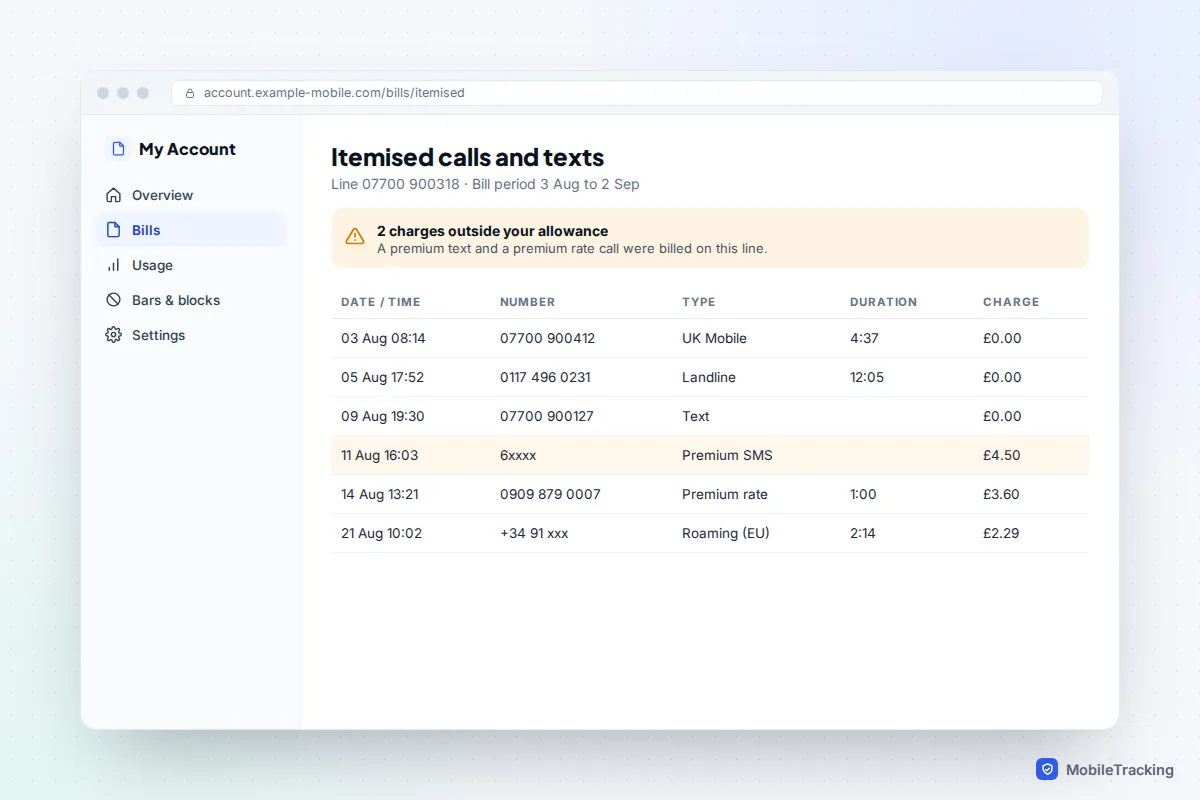
What each column on an itemised bill means
Carriers lay the table out differently, but the same information appears on almost every bill.
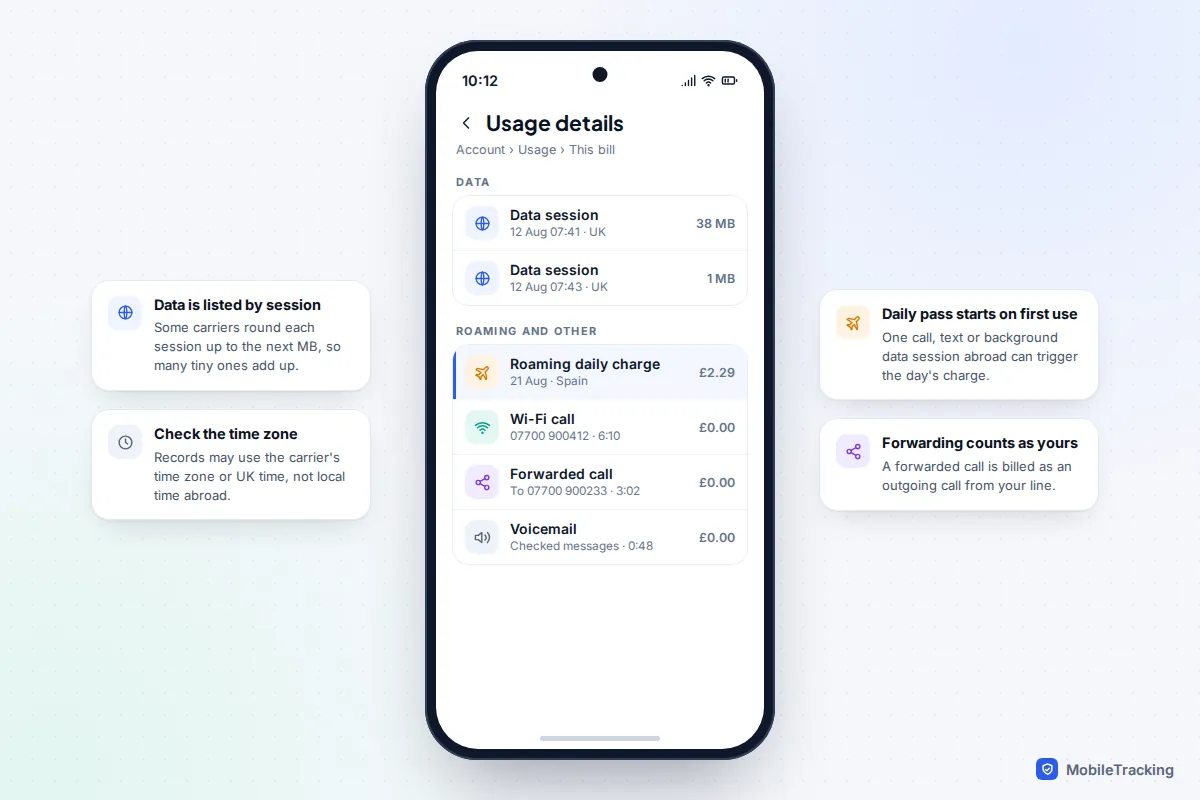
- Date and time. When the call started, not when it ended. The time zone may not be yours: T-Mobile, for example, says its data and text usage is shown in Pacific Time. Calls made abroad are often listed in your home country’s time, which is why a 9pm call in Spain can appear as 8pm.
- Number. The number you called or texted. On US bills, incoming calls appear too. Verizon notes that it shows 999-999-9999 when its system can’t identify a number.
- Destination or type. A label such as UK Mobile, Landline, Voicemail, International, Roaming, Premium or Short Code. This label decides which rate applied, so it matters more than the number itself.
- Duration. Shown as minutes and seconds, or rounded minutes. AT&T, for instance, rounds voice usage up to the next whole minute, so a 61-second call counts as two minutes. UK tariffs vary: check your price guide to see whether out-of-bundle calls are billed per second or per minute, and whether there’s a connection charge.
- Charge. The cost of that line after any allowance. A line can show a long duration and £0.00, which simply means it came out of your bundle.
Duration is where most honest confusion comes from. The figure on your bill can be a few seconds longer than the one on your phone, because the network measures from when the call connects on its side, and rounding can add more. A difference of a minute or two on a short call is normal. A 40-minute call you never made is not.
Number types and codes to recognise
The first digits of a number tell you roughly what it cost. In the UK, Ofcom’s UK Calling rules split calls to service numbers into an access charge (set by your network, per minute) and a service charge (set by the organisation you called). Your bill often shows them as one figure.
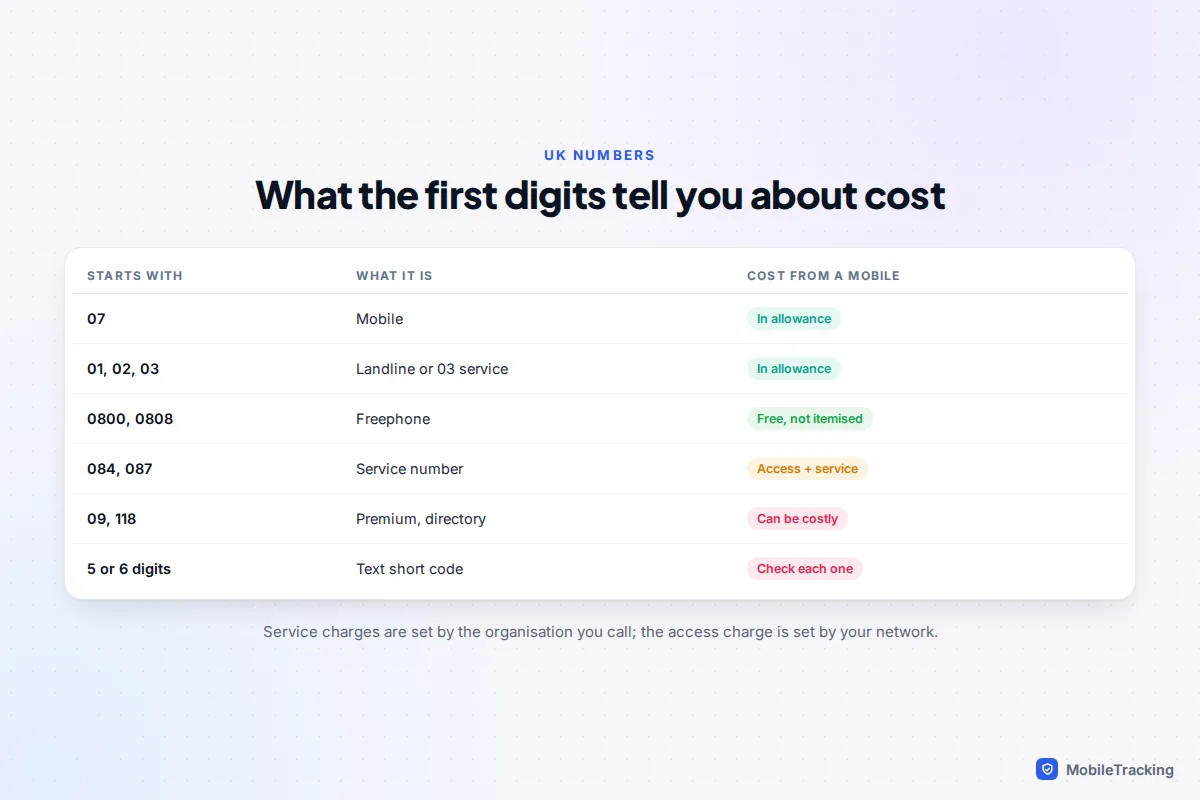
UK numbers
- 07 is mobile, and 01, 02 and 03 are charged like landlines, so all of them normally come out of your allowance.
- 0800 and 0808 freephone numbers have been free from mobiles since 2015. Ofcom’s rules also say freephone calls shouldn’t appear on itemised bills at all, which protects people calling helplines.
- 084, 087, 09 and 118 carry a service charge on top of your network’s access charge. 09 numbers are premium rate and 118 numbers are directory enquiries, both regulated by Ofcom since it took over from the Phone-paid Services Authority in January 2025.
- Short codes are five or six digit numbers used for texts. Ofcom says chargeable ones usually start with 5, 6, 7 or 8, and charity donations typically use a code beginning 70.
US numbers
- Toll-free numbers start 800, 833, 844, 855, 866, 877 or 888.
- 900 numbers are pay-per-call services and can be expensive.
- Some Caribbean area codes, such as 809 and 876, look like US numbers but are international. They are a favourite of “one-ring” scams, where a missed call tempts you to ring back at international rates.
Data, roaming and other entries
Data usually appears as sessions, each with a start time and the amount used. AT&T rounds each data session up to the nearest megabyte, so many tiny sessions can add up to more than your phone’s own counter shows. Roaming lines are labelled with the country or a daily pass. UK providers must send you an alert explaining roaming charges when you arrive in another country, and should help Northern Ireland customers avoid accidentally connecting to Irish networks near the border. Call forwarding shows as an outgoing call from you, because you pay for the forwarded leg.
UK and US bills: the main differences
If you’ve moved country, or you’re helping a relative on the other side of the Atlantic, the same bill can look very different.
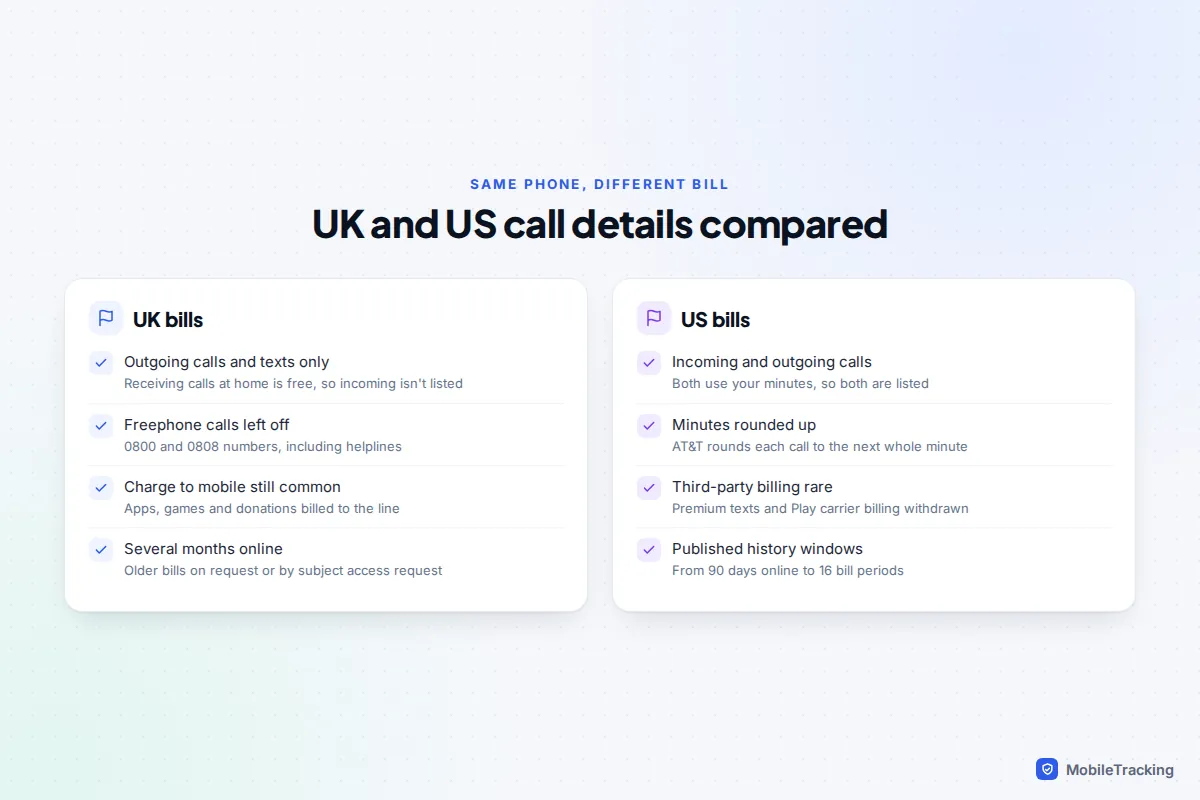
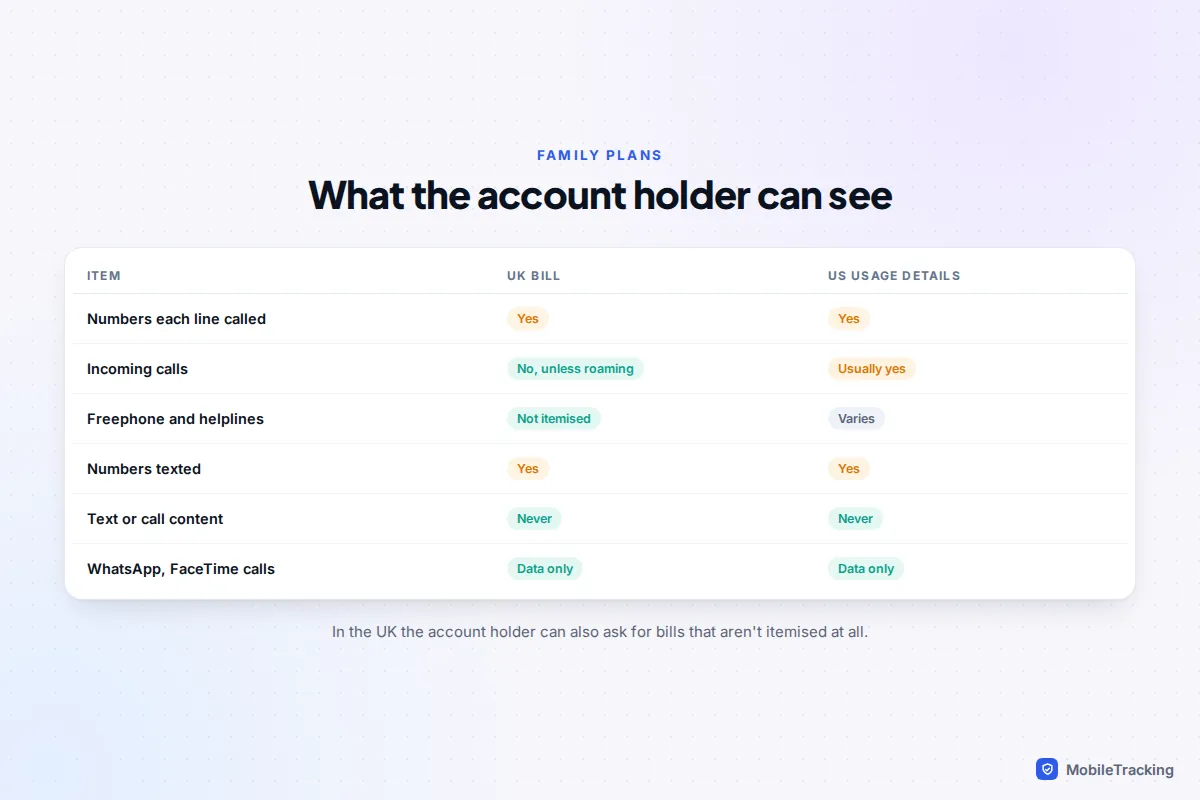
- Incoming calls. In the UK the caller pays, so incoming calls normally don’t appear unless you were roaming. US carriers list incoming and outgoing calls, because both use your minutes.
- Helplines. UK freephone calls are left off itemised bills. Childline says calls to 0800 1111 won’t show on the bill, and Samaritans says the same of 116 123.
- How far back you can see. US carriers publish their windows: AT&T shows usage for up to 16 bill periods, T-Mobile lets you print up to a year of records, and Verizon’s website shows usage summaries for the past 90 days. UK networks usually keep several months of bills online; older ones are available on request.
- Third-party billing. UK networks still let you charge apps, subscriptions and donations to your bill. In the US, the big carriers stopped billing most premium texts in 2013, and Verizon, AT&T and T-Mobile have all withdrawn Google Play carrier billing, so third-party charges are much rarer there.
How to spot charges you didn’t expect
Work through the charged lines only. For each one, ask what it is, who on the account made it, and whether they meant to. If you have a family plan, check each line separately, since the total can hide one phone’s problem.
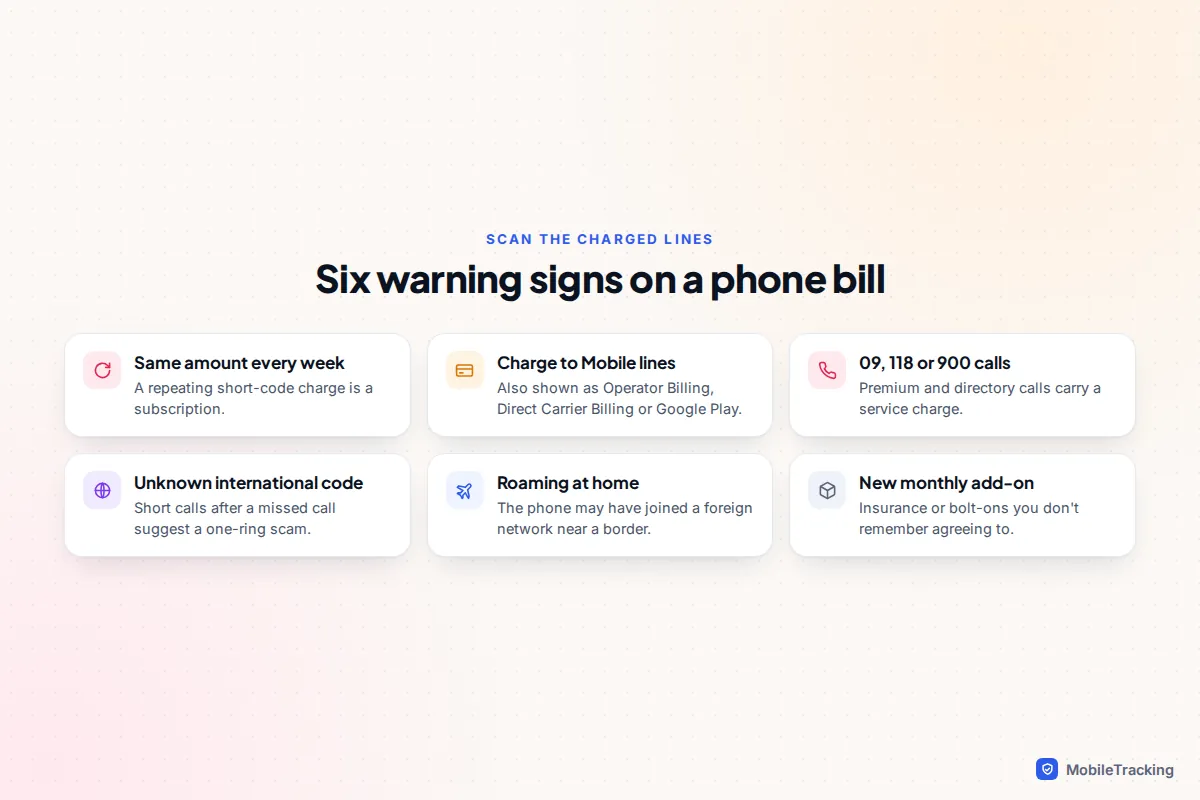
Watch for these patterns:
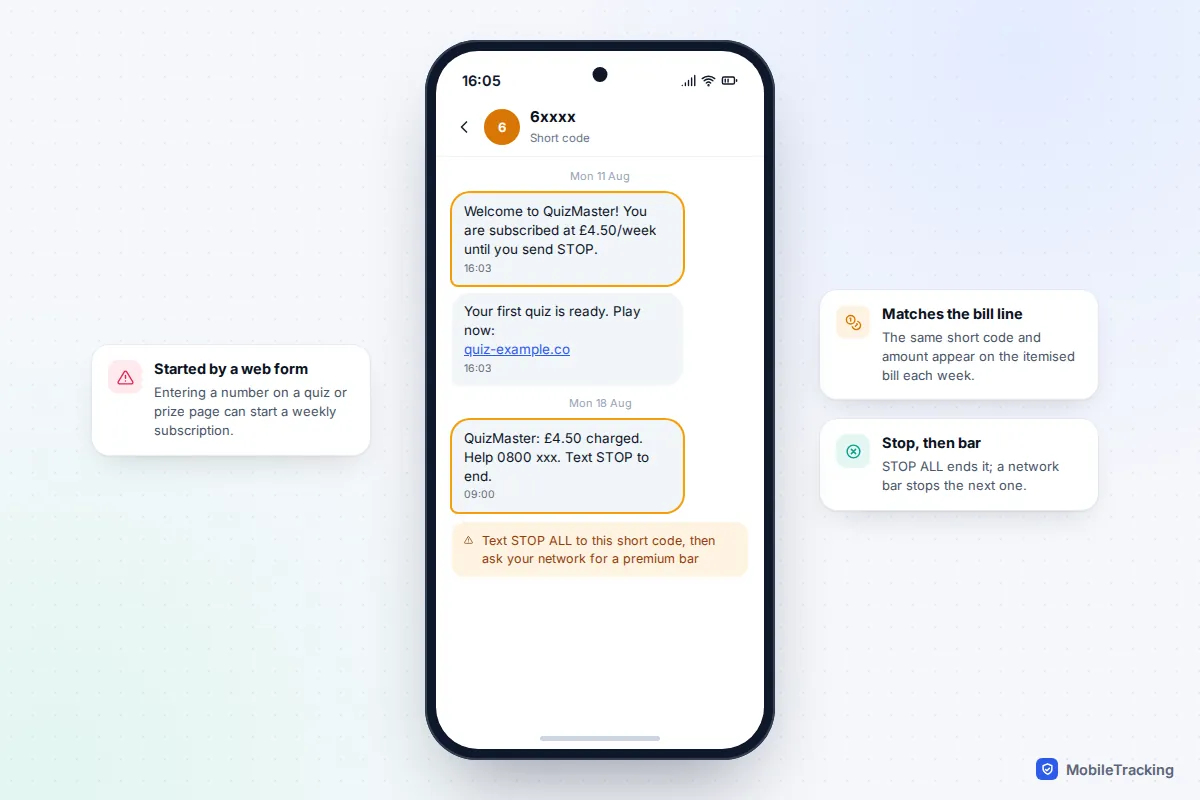
- Repeating short-code charges at the same amount every week. That’s a subscription, often started by entering a number on a quiz, game or competition page.
- Lines labelled Charge to Mobile, Operator Billing, Direct Carrier Billing or Google Play. These are purchases, not calls. On a child’s phone they are usually in-app purchases or game credits.
- Calls to 09, 118, 900 or unfamiliar international codes, especially short ones straight after a missed call.
- Roaming charges on days you weren’t abroad, which can mean the phone connected to a foreign network near a border or at sea.
- New monthly add-ons you don’t remember agreeing to, such as insurance or a streaming bolt-on.
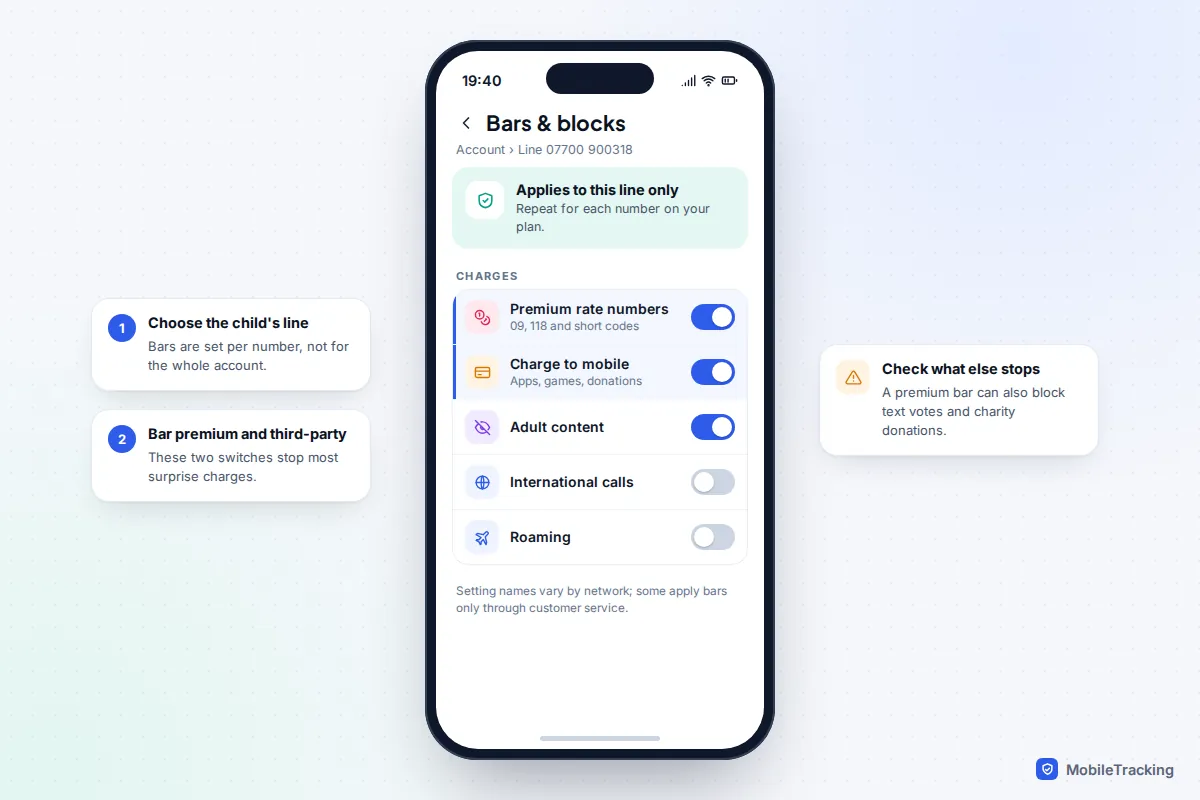
A typical case: a parent sees £4.50 appear four times on a 13-year-old’s line, each from the same five-digit number. The child remembers entering the phone number on a “which character are you” quiz. Texting STOP ALL to the short code ends the subscription, a bar stops it happening again, and the parent then asks the service for a refund (more on that below). If the problem is scam calls rather than charges, our guide on reporting a scam call covers where to send the details.
Block premium and third-party charges
Stopping an existing charge and preventing new ones are two different jobs.
Stop a subscription that’s already running
Ofcom advises texting STOP ALL to the number the service gave you, rather than replying to a random message in the thread. If you can’t tell who is charging you, your network can identify the provider from the number on your bill, and Ofcom’s guide to stopping premium rate charges explains the next steps. Then check the phone’s app store subscriptions, because some services bill through the store instead.
Bar it at the network
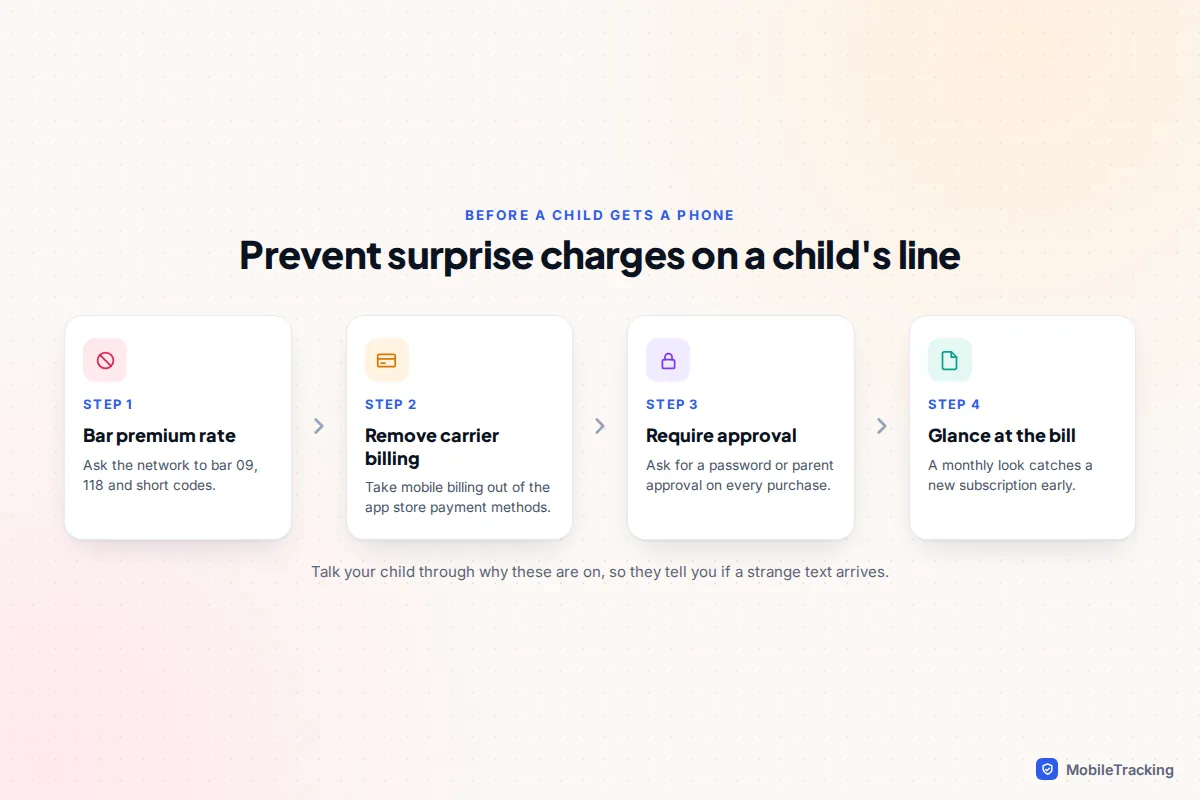
In the UK, payments charged to your bill are capped by the Payment Services Regulations at £40 per transaction and £240 per billing period, but that can still be a lot for a child’s line. Ask your network to bar premium rate numbers and third-party charges on the line; some let you do it yourself. Vodafone offers a bar that stops all charge-to-bill purchases and a Spend Manager for monthly limits. In the US, AT&T has a Purchase Blocker add-on that stops purchases billed to your wireless account, and other carriers offer similar blocks through their apps or customer service.
Remove carrier billing on the phone
On Android, open the Play Store, tap your profile picture, then Payments & subscriptions › Payment methods, and remove the mobile billing option if it’s listed. On iPhone, go to Settings, tap your name, then Payment & Shipping. For a child, it’s also worth requiring a password or approval for every purchase.
Family plans and privacy
Whoever holds the account normally sees the itemised details for every line on it. In the UK that means the numbers each line called or texted, with times and durations. In the US it usually includes incoming calls too. No bill anywhere shows what was said or the content of texts.
This cuts both ways. For a teenager, knowing that the bill payer can see their numbers is fair information to share openly, and it’s better to agree what you’ll check than to surprise them with a printout. The helpline exclusions exist for a reason: a young person can ring Childline or Samaritans without it appearing on the family bill.
For adults, sharing an account can be a privacy risk. UK privacy rules let the account holder ask for bills that aren’t itemised at all. If you’re on someone else’s plan and worried about them monitoring you, moving to your own account is the reliable fix, and support is available from Refuge (0808 2000 247) in the UK or The Hotline (1-800-799-7233) in the US.
Getting older call records
Your bill is usually the longest record of your calls you can easily get. Phones keep a limited list, and an iPhone’s call history is roughly the last 100 calls. If you’ve cleared your phone’s log, our guide to seeing cleared call history explains why the carrier record is the dependable copy.
- Sign in to your carrier’s app or website and look under Bills, Usage or Itemisation. Download a PDF or CSV if offered.
- For older periods, ask customer service for copies of past itemised bills or a full call record. Ask specifically for incoming calls if you need them.
- In the UK, if the network won’t help, make a subject access request under data protection law. They normally have one month to respond.
Only the account holder can request records, and carriers need proper legal process to release another person’s call history. Our guide to recovering call logs from your carrier goes through the request in more detail.
How to dispute a charge
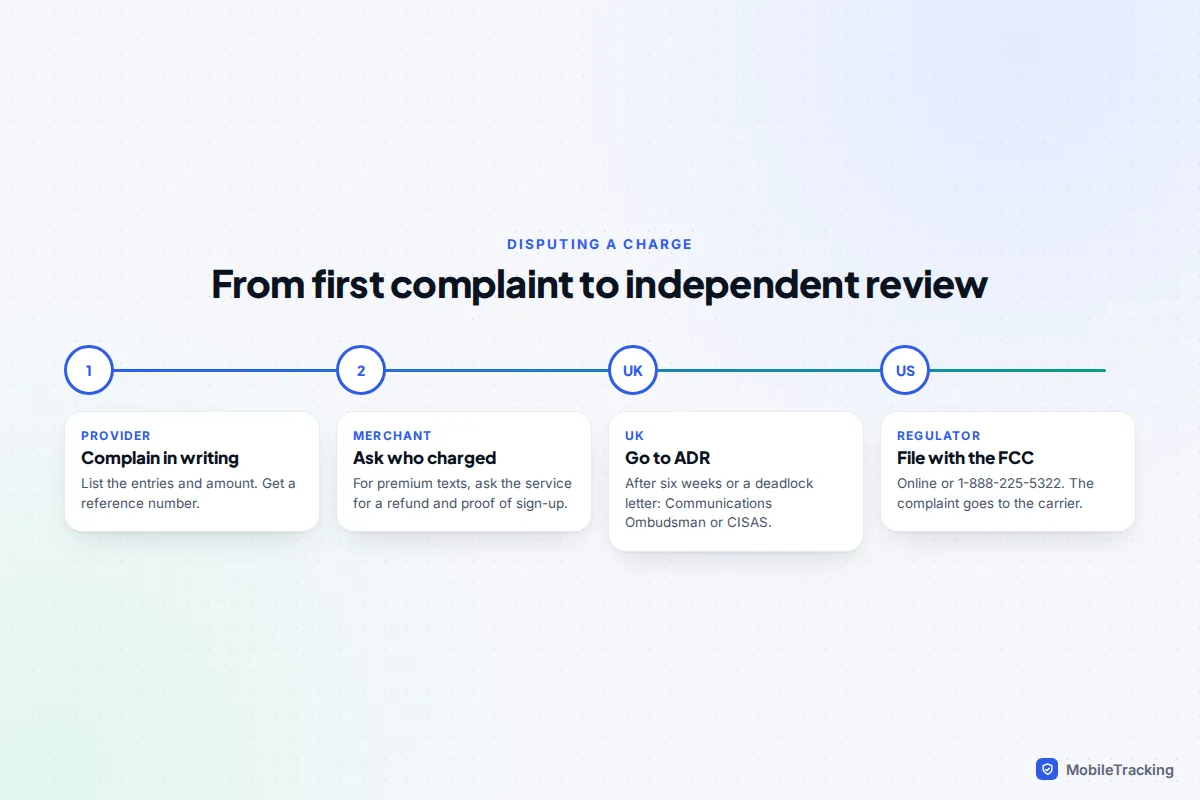
Keep it simple and put everything in writing. You’ll need the bill date, the line number, the exact entries and the amount.
In the UK
- Complain to your network and ask for a complaint reference. For premium texts, also ask the service provider for a refund, and ask them for proof of what you signed up to if they refuse.
- If it isn’t resolved after six weeks, or the provider sends a “deadlock” letter, you can take it to alternative dispute resolution. Ofcom cut the wait from eight weeks to six from 8 April 2026. Your provider will belong to either the Communications Ombudsman or CISAS, and the service is free to you.
- For premium rate services breaking the rules, report them to Ofcom on 0300 123 3333 or through its complaint form. Ofcom won’t negotiate your refund, but it does act on patterns of complaints.
In the US
- Call your carrier and ask for the charge to be removed, and contact the company that placed it if it’s a third-party charge.
- If that fails, file a complaint with the FCC online or on 1-888-225-5322. The FCC’s guide to filing an informal complaint explains what happens next: it’s sent to your carrier, which has to respond.
- For charges that aren’t phone services, such as a scam subscription billed another way, report to the FTC instead.
Frequently asked questions
Why does my bill show a call as longer than my phone did?
The network times the call from its own connection point and may round up to the next minute or add a connection charge. A few seconds’ difference, or a minute’s difference after rounding, is normal. Large gaps are worth querying.
Why aren’t incoming calls on my UK bill?
Because you don’t pay for them. UK bills list chargeable activity, and receiving calls at home is free. Ask your network for a full call record if you need incoming calls.
Will deleting a call from my phone remove it from the bill?
No. Your phone’s log and the carrier’s records are separate. Deleting on the phone changes nothing on the bill.
Do WhatsApp or FaceTime calls show on a phone bill?
Not as calls. They use mobile data or Wi-Fi, so at most you’ll see data usage, with no number or contact attached.
Can I get a refund for a premium text subscription my child signed up to?
Often, yes. Ask the service provider first, then your network. If the sign-up wasn’t clear or your child didn’t confirm it, say so, and keep the texts as evidence.